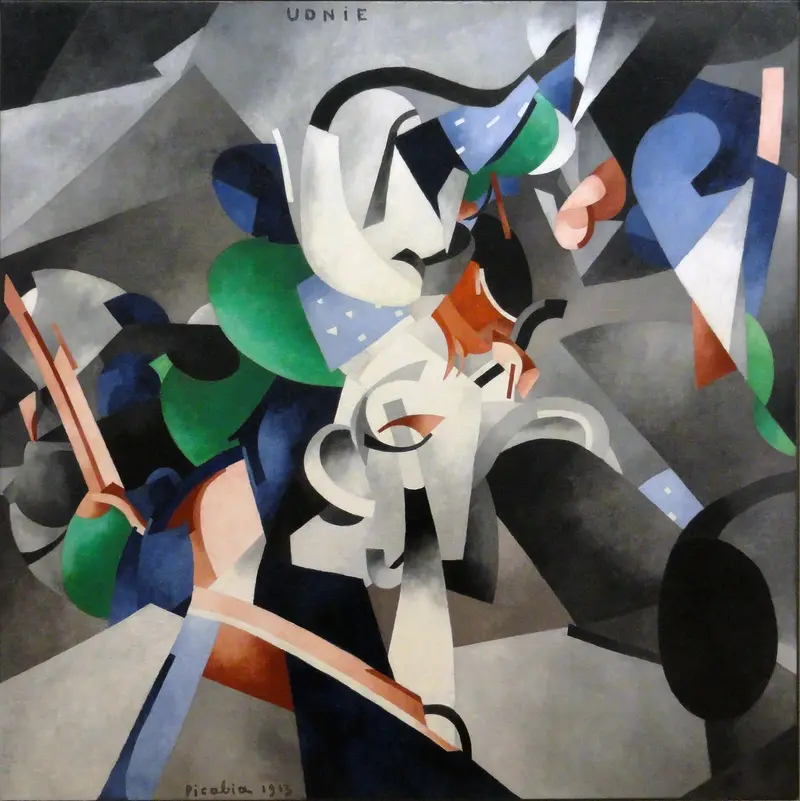
Picture with a Black Arch: what it shows and where it is
A large black arc holds back three blocks of colour that are ready to collide, the Centre Pompidou says of Picture with a Black Arch (Mit dem schwarzen Bogen in German, Avec l’arc noir in French). Wassily Kandinsky (1866–1944) made the square canvas in Munich in 1912. It belongs to the Musée National d’Art Moderne in Paris, which links the arc to the douga, a part of the traditional Russian harness for three horses.
- A piece of harness: The museum says the black arc is inspired by the douga. Its longer analysis describes the large black sign at the centre as recalling the shaft bow of a troika, made of irregularly shaped elm wood that tends toward a semicircle.
- Dissonance as construction: In a letter to Arnold Schönberg dated 22 August 1912, while the canvas was being finished, Kandinsky wrote that construction can also be reached on the “principle” of dissonance. The museum compares the picture’s search to Schönberg’s use of dissonance in music.
- A last-minute swap for Berlin: On 20 September 1912 Kandinsky wrote to Walden that he would leave Improvisation 27 behind and send this picture in its place, for room II of his first solo exhibition at the Der Sturm gallery.
- A square with a clipped corner: According to the museum, a triangle upsets the symmetry of the square canvas, and Kandinsky chips the upper-left corner of the picture with a kind of circumflex accent.
- Münter, Zwickau, Paris: The museum records that the canvas stayed with Gabriele Münter until 1926, was briefly deposited at the König-Albert Museum in Zwickau that year, and surfaced in Paris exhibitions in 1937 and 1939. Oil on canvas, 189 × 198 cm; a gift of Nina Kandinsky in 1976 (inventory AM 1976-852).
Sources: Centre Pompidou: collection record AM 1976-852 · Wikidata Q3708870
Questions and answers about the painting
What does Picture with a Black Arch show?
It is an abstract painting, so it shows no recognisable scene. The Centre Pompidou describes a large black arc that holds back three blocks of colour ready to collide; the museum’s text speaks of “three continents colliding” held in tension by the arc. It adds that the lines separate from the colours, with shimmering touches, creating many matches and mismatches. Its keywords include Der Blaue Reiter, abstraction and square format.
Which museum owns Kandinsky’s 1912 painting with the black arc, and can I see it?
It belongs to the Musée National d’Art Moderne at the Centre Pompidou in Paris (inventory AM 1976-852), which received it from Nina Kandinsky in 1976. The museum’s record, read in November 2026, says it has been lent to Palazzo Bonaparte in Rome for a Kandinsky exhibition. Whether it is back on the walls in Paris when you go is something only the museum can confirm.
Source: Centre Pompidou: collection record AM 1976-852 · Wikidata Q3708870
What is the black arc in Kandinsky’s painting based on?
The museum says the arc is inspired by the douga, a part of the traditional Russian harness for three horses. Its analysis adds that the large black sign at the centre recalls the troika’s shaft bow, made of irregularly shaped elm wood that tends toward a semicircle, and that the sign is also a triangle that upsets the symmetry of the square canvas.
When and where did Wassily Kandinsky paint this canvas, and where did it go next?
The Centre Pompidou records that it was made in Munich in autumn 1912, and the canvas is inscribed with that year. The museum’s analysis cites Kandinsky’s letter of 22 August 1912 to Arnold Schönberg, in which the canvas was being completed, and his letter of 20 September to Walden, sending it to his first solo exhibition at the Der Sturm gallery in Berlin in place of Improvisation 27. The museum’s “autumn 1912” thus sits a little later than the August letter, which shows the canvas already nearly finished.
What are the size and materials of Kandinsky’s black arc canvas?
Picture with a Black Arch measures 189 × 198 cm and is painted in oil on canvas, according to the Centre Pompidou, which files it under square format. The record lists the inscription “KANDINSKY i9i2”. Wikidata gives the same height and width and records oil paint on canvas.
Source: Centre Pompidou: collection record AM 1976-852 · Wikidata Q3708870
Is Kandinsky’s black arc painting in the public domain and free to download?
Yes, in most places. Wassily Kandinsky died in 1944 and this painting dates from 1912, so it is in the public domain in the European Union and in other countries that protect works for the author’s life plus 70 years or less, and in the United States for works published before 1931. A few countries protect works for longer. A faithful photograph of a public-domain painting adds no new copyright in the United States or the European Union, so in those countries you can download this image for personal or commercial projects. Public Domain Images for Commercial Use explains how.
Source: Wikidata Q61064 (Wassily Kandinsky, died 13 December 1944) · Wikidata Q3708870
More Artworks by Wassily Kandinsky

Improvisation 35
Wassily Kandinsky
Composition VI
Wassily Kandinsky
Several Circles
Wassily Kandinsky
Composition VII
Wassily Kandinsky
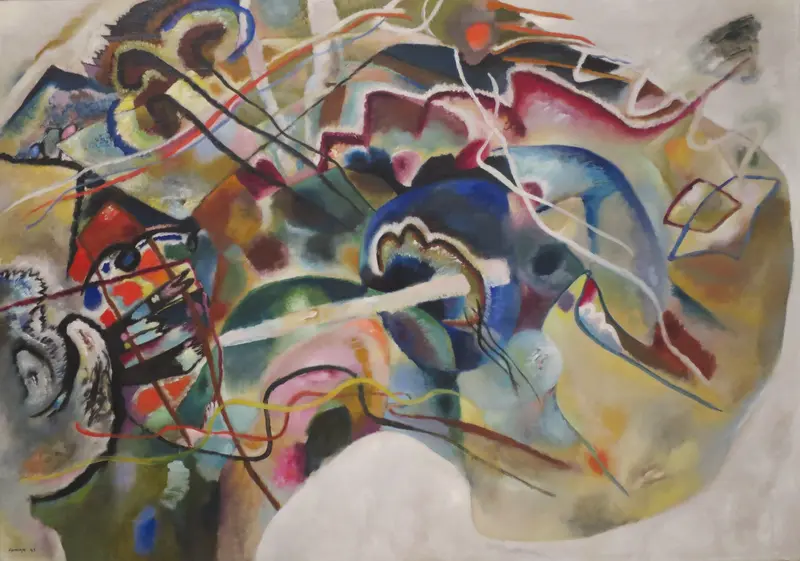
Painting with White Border
Wassily Kandinsky
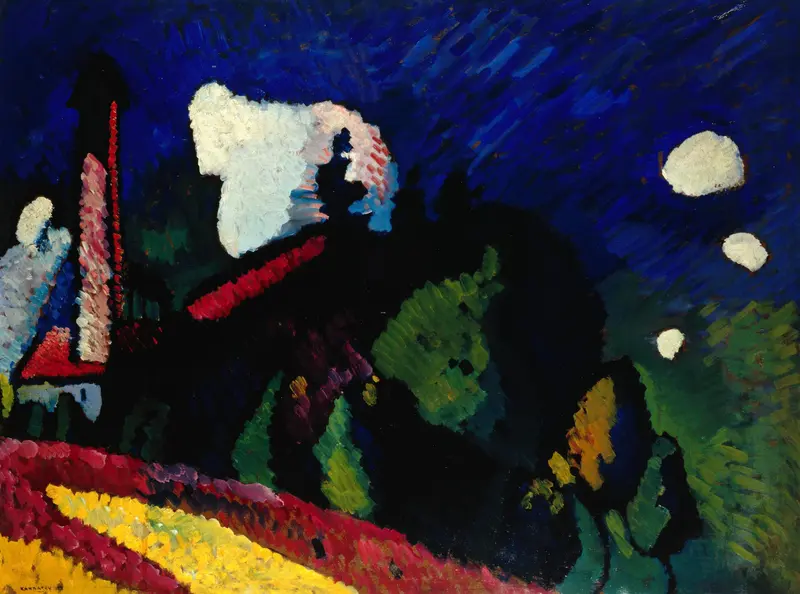
Murnau, Landscape with a Tower
Wassily Kandinsky
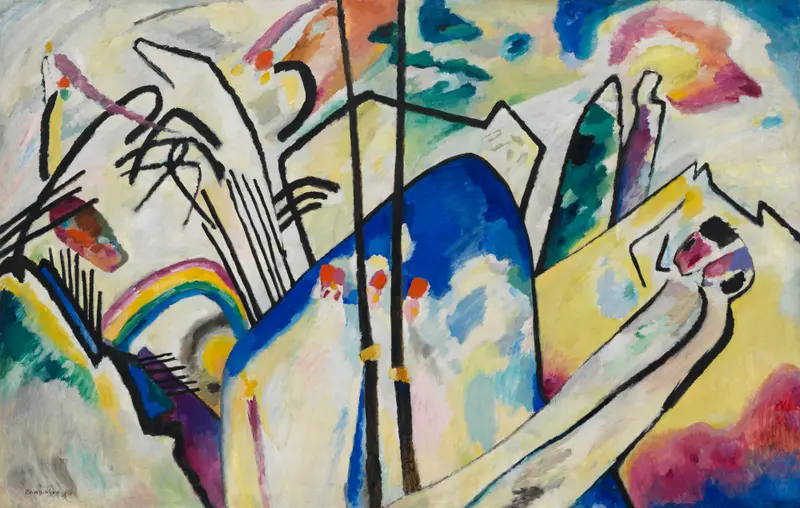
Composition IV
Wassily Kandinsky
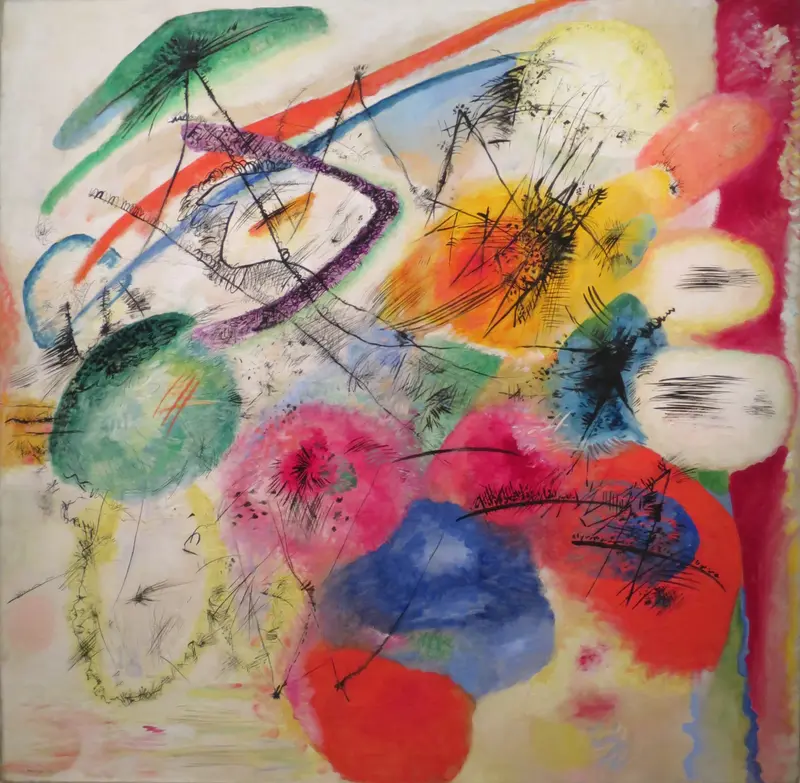
Black Lines
Wassily Kandinsky
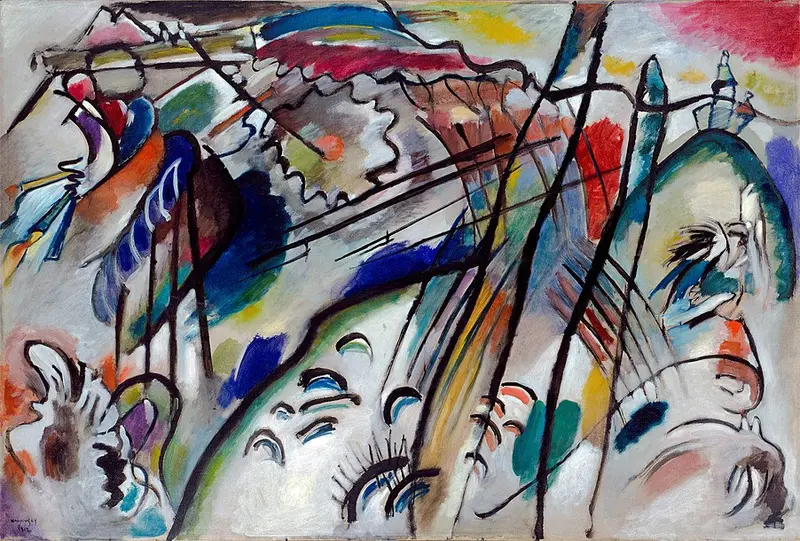
Improvisation 28 (second version)
Wassily Kandinsky

Improvisation No. 30 (Cannons)
Wassily Kandinsky