Portrait of a Highlander boy — History & Facts
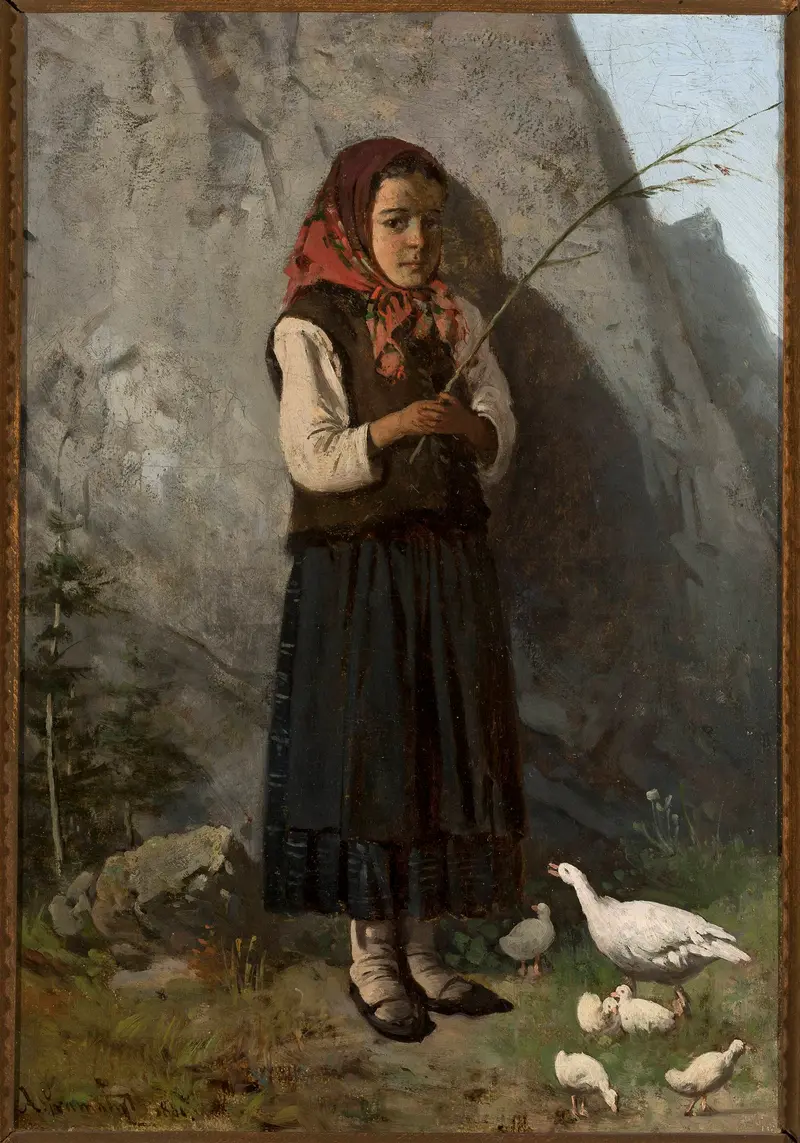
What first draws the eye in Portrait of a Highlander boy is the quiet self-possession of its young subject, standing with a shepherd’s staff against a backdrop of rugged hills. His clothing, rough and practical, marks him as a child of the mountains, and the painter, Antoni Gramatyka, lingers over the textures: the heavy folds of his cloak, the battered leather of his shoes, the red thread at his knee. The boy’s stance is both guarded and at ease, his gaze direct but not challenging, as if he is pausing in his work to measure the viewer as much as he is being measured.
Light falls from the right, picking out the subtle pink in his cheeks and the curve of his hat, while the shadowed greenery behind him hints at a world both wild and familiar. This is not a portrait of nobility or grandeur, but of everyday resilience, rendered with a painter’s affection for the ordinary. Painted in 1878, this work belongs to a moment in European art when artists looked to rural life for authenticity and national character. In Poland, where Antoni Gramatyka worked, such images carried a special weight: the countryside was both a source of tradition and a symbol of endurance under foreign rule.
Portraits like this one, now held in the National Museum in Warsaw, were rarely grand commissions but rather acts of documentation and homage, capturing the faces of those who might otherwise pass unrecorded. The Highlander’s world, with its wooden fences, sheep in the distance, and sturdy clothing, speaks of a culture both local and enduring. Look again at the boy’s hands—one gripping the staff, the other resting lightly—caught between childhood and the responsibilities of the land.