Regent Street, London — History & Facts
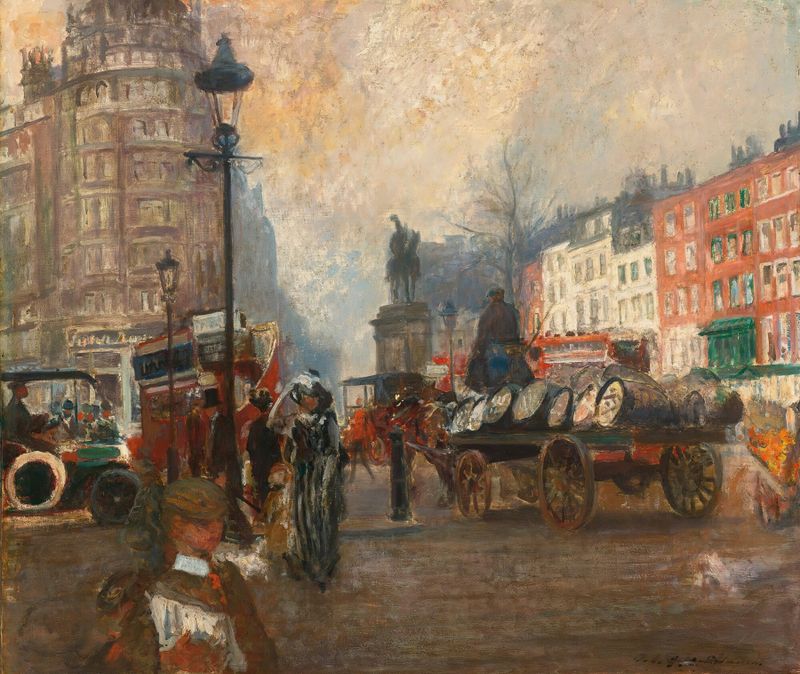
Where does light end, and longing begin? The interplay between illumination and shadow whispers secrets of the heart, beckoning us to explore the spaces in between. Look to the left at the striking contrast of the warm, golden hues that define the sunlit buildings, casting long shadows onto the cobblestone street below. The figures, caught mid-stride, offer a glimpse into daily life, their silhouettes softly outlined against the brilliance of the sky. Note how the artist's brushstrokes create a lively rhythm, guiding the eye along Regent Street, while the careful placement of light draws attention to the intimate details of street vendors and passersby, enhancing the scene’s bustling energy. In this artwork, one can find a tension between the vibrancy of urban life and the solitude of the individual.
The scattered pedestrians seem to navigate not only the physical street but also an emotional landscape, each lost in their thoughts or connections with others. The soft blending of colors can suggest fleeting moments, where light captures not just the external world, but the inner yearnings of those who traverse it, hinting at the dreams and aspirations that color the fabric of city life. During the late 19th century, when this piece was likely created, Jacques-Émile Blanche found himself in an art world transitioning toward modernity, grappling with the effects of Impressionism and the emergence of new artistic movements. Living in Paris, he was part of a vibrant community of artists, which allowed him to absorb diverse influences and reflect upon the rapid changes happening around him, both socially and artistically.
This painting, though not dated, embodies those transitional themes of light, movement, and human experience.