
Saint Thomas (small version) — History & Facts
Few paintings by El Greco have inspired as much curiosity as Saint Thomas (small version), one of several renditions the artist made of Christ’s doubting apostle in his final years. This work belongs to a celebrated series of apostle portraits, created around 1610 in Toledo, which were often repeated in different sizes and arrangements—sometimes for private devotion, sometimes for church commissions. The existence of multiple versions has led scholars to debate which came first, and whether this particular painting was intended for a specific patron or as part of a larger set.
The mystery is heightened by the fact that the medium remains uncertain, a rarity for a work from El Greco’s meticulously documented late period. Saint Thomas (small version) captures the apostle at the moment of searching inquiry, his eyes lifted in a mixture of skepticism and yearning. In Christian tradition, Thomas is remembered for demanding proof of Christ’s resurrection—his hand reaching toward the wound, his mind caught between doubt and faith. Here, El Greco isolates Thomas against a stormy, abstract background, his elongated fingers and angular features rendered with the artist’s characteristic distortion.
The apostle’s gesture, hand pressed to his chest, signals both humility and a restless need for truth. Unlike Caravaggio’s tactile, almost forensic approach in his own The Incredulity of Saint Thomas, El Greco offers a more spiritual, psychological portrait, where the drama unfolds in the eyes and hands rather than in physical contact. The journey of this particular painting is less well documented than some of its larger counterparts. While many of El Greco’s apostle portraits were commissioned for the parish church of Almadrones or for private chapels in Toledo, the provenance of Saint Thomas (small version) remains unclear, with gaps in its early history and uncertainty about its original owner.
Over the centuries, it has been recognized as a prime example of the artist’s late style, when his forms grew more abstract and expressive. Today, it stands as a testament to El Greco’s unique vision at the twilight of the Spanish Renaissance, inviting viewers to ponder faith, doubt, and the enduring power of the painted image.
More Artworks by El Greco
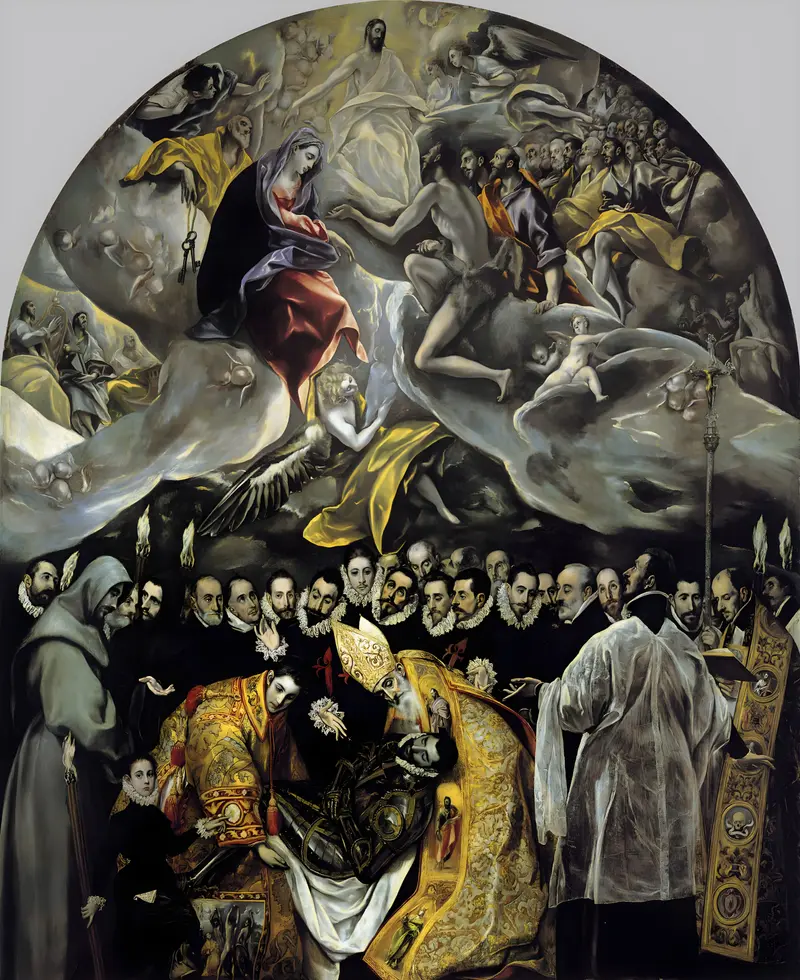
The Burial of the Count of Orgaz
El Greco

Portrait of an Apostle (Saint Philip)
El Greco

Saint Luke the Evangelist
El Greco

The Immaculate Conception
El Greco

The Feast in the House of Simon
El Greco

View of Toledo
El Greco

Saint Ildefonso
El Greco

The Disrobing of Christ
El Greco

The Vision of Saint John
El Greco

The Marriage of the Virgin
El Greco





