
Swapping Lies — History & Facts
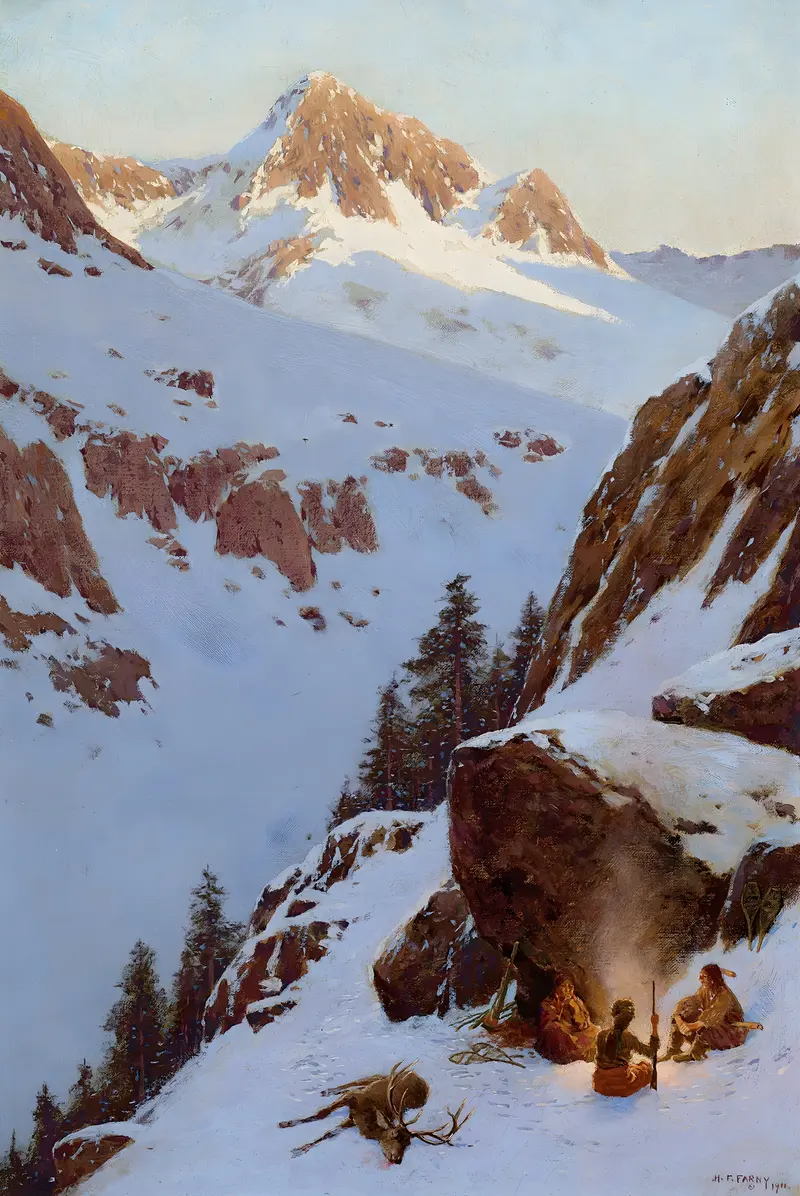
What if beauty was never meant to be finished? In Swapping Lies, Henry Farny invites us into a moment steeped in the promise of human connection, revealing the intricate dance of truth and deception that binds us all. Look to the left at the two figures seated by the fire, their faces aglow in the warm light. The soft, earthy palette of browns and oranges envelops them in an intimate warmth, contrasting with the cool blues and greens of the surrounding wilderness. Notice how the light flickers, casting playful shadows that tease the boundaries of reality and imagination, making their conversation feel both urgent and timeless.
The composition draws us in, creating a circle of shared experience that is both inviting and introspective. Beneath the surface, Farny captures the essence of storytelling as a means of survival and hope. The tension lies in their expressions: one man leans closer, his eyes filled with mischief; the other appears contemplative, lost in thought, hinting at deeper truths hidden within the fabric of their exchange. The fire, a symbol of warmth and safety, also represents the fragility of trust, as each lie told could either strengthen their bond or unravel it entirely. In 1906, Farny was living in the United States, immersed in the world of American art that was evolving alongside a nation wrestling with its identity.
He was known for his depictions of Native American life, blending realism with emotional depth. Swapping Lies reflects a period when the artist was honing his ability to portray not just the external world, but the internal landscapes of human interaction, celebrating the complexities of life in a rapidly changing society.
More Artworks by Henry Farny

More Genre Scene Art

Banquet of the Officers of the St George Civic Guard
Frans Hals

Rembrandt and Saskia in the Scene of the Prodigal Son
Rembrandt van Rijn

Bal du moulin de la Galette
Pierre-Auguste Renoir

Quadrille at the Moulin Rouge
Henri de Toulouse-Lautrec

A Burial at Ornans
Gustave Courbet

When Will You Marry?
Paul Gauguin