
The Ferry Crossing — History & Facts
What if beauty was never meant to be finished? In the strokes of Constant Troyon’s The Ferry Crossing, we find a moment suspended between the ordinary and the sublime, where nature’s chaos dances with humanity’s quest for order. Look closely at the lower right corner, where the flickering reflections of the water merge with the shadows of the figures. Notice how the muted palette of earth tones evokes a sense of solemnity, while the crisp white of the boat cuts through the scene like a whispered invitation. The composition carefully balances the weight of the ferry and its passengers against the expansive turbulence of the sky, revealing Troyon’s deft hand in capturing movement and stillness simultaneously. Yet beneath this tranquil surface lies an undercurrent of tension, suggesting a world teetering on the brink of madness.
The figures, caught between their destination and the wildness of the landscape, embody the struggle between human resolve and nature’s indifference. The stormy sky above threatens to engulf all in its path, prompting reflection on the fleeting nature of beauty and the chaos that often accompanies it. During the years 1860 to 1865, Troyon was immersed in the burgeoning Barbizon school, exploring the intimate relationship between man and nature. His works reflected the turbulence of the times, as Europe grappled with social upheaval and the advent of modernity.
This painting, created amidst these shifting paradigms, encapsulates a moment of serenity that belies the madness of the world outside the canvas.
More Artworks by Constant Troyon
Browse all →
Landscape with Painter at Easel
Constant Troyon

The Marsh
Constant Troyon
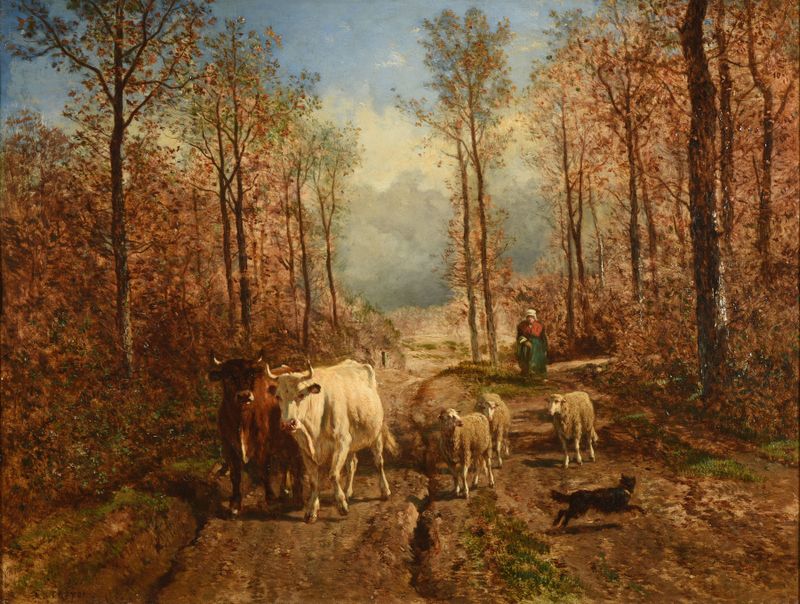
Rentrée de troupeau
Constant Troyon

Vaches sous bois
Constant Troyon

La gardeuse d’oies
Constant Troyon

Mill Stream with Fishermen
Constant Troyon

Landscape
Constant Troyon

Pasture in Normandy
Constant Troyon

Paysage
Constant Troyon

The Road to Market
Constant Troyon





