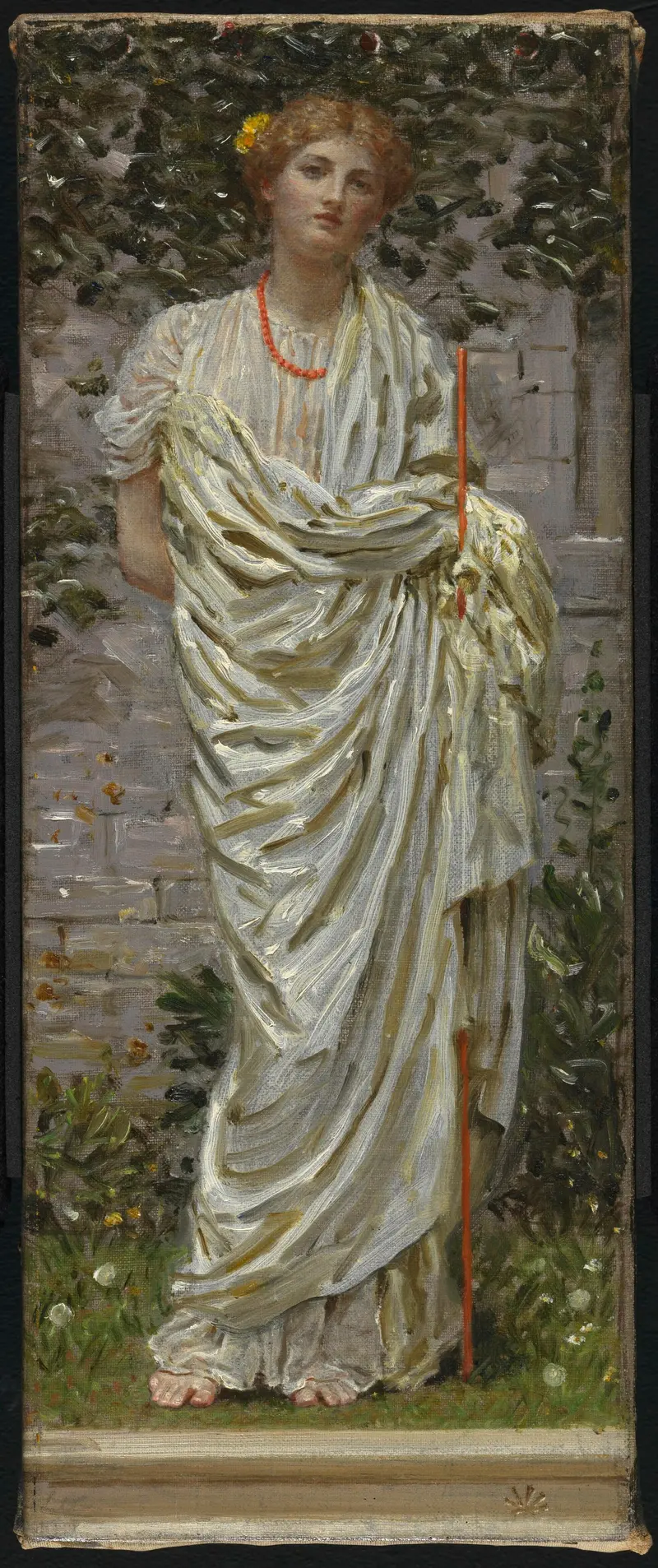
The Quartet, a Painters Tribute to Music — History & Facts
What first catches the eye in The Quartet, a Painters Tribute to Music is the hush of anticipation that hangs between the figures, as if the next note is about to bloom in the air. The arrangement is almost theatrical: three women, their arms entwined, form a gentle arc facing the musicians, their gauzy drapery echoing the ancient world. Two violinists and a cellist, all draped in classical robes, play with intent focus, while a fourth figure, holding a staff and clad in a leopard skin, looks on—a nod, perhaps, to the mythic or the ceremonial.
Overhead, a shelf balances vases of spring blossoms and a massive stringed instrument, its presence both decorative and symbolic, suggesting the harmony between visual and musical arts. The palette is restrained, all dusty roses and creams, lending the scene a sense of calm and unity, as if the music itself has stilled time. Painted in 1868 by Albert Joseph Moore, this work belongs to a moment in Victorian Britain when artists looked back to antiquity for inspiration, blending classical ideals with the era’s own fascination for beauty and leisure. Such paintings, often commissioned for domestic interiors or exhibitions, offered viewers a retreat from industrial modernity into imagined worlds of grace and order.
Moore, known for his devotion to decorative harmony and the female form, here pays tribute to music as a civilizing force, a theme that resonated with the cultured audiences of his day. History has kept few traces of this specific painting’s journey, but its inclusion in a modern online collection reminds us how 19th-century artists reimagined the ancient past to address their own present. The longer you look, the more the painting’s quiet conversation between music, art, and memory reveals itself.