
Waldlandschaft mit einem Fuhrwerk im Hintergrund — History & Facts
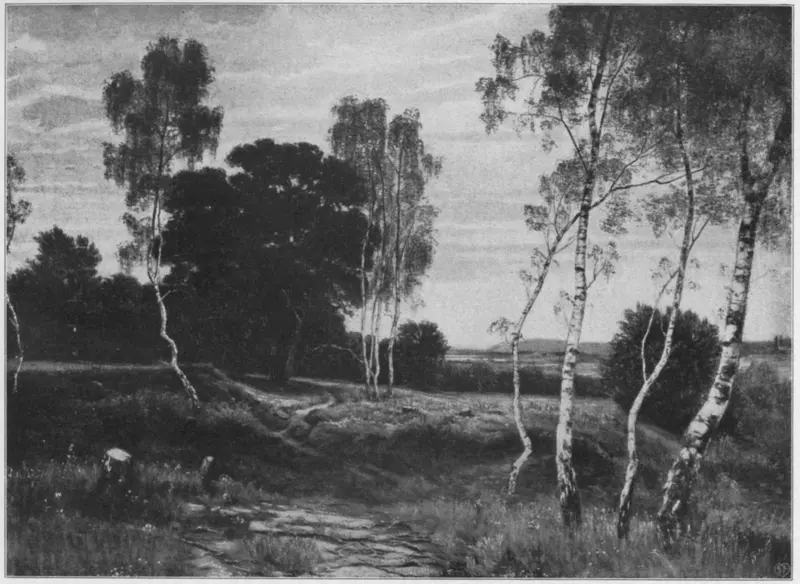
A shaft of pale light draws the eye down a winding track, where the forest briefly parts to reveal a solitary cart making its slow way into the shadowed green. The hush of the woods is almost audible here: tangled undergrowth presses close, and the trees arch overhead, their leaves painted in thick, living greens. The path itself is rutted and uneven, guiding us toward the distant figures—driver, horse, and wagon—who seem both sheltered and dwarfed by the landscape around them.
The artist’s brushwork lingers on the play of light and shade, suggesting a moment of pause, as if the forest is holding its breath. Painted by Adolf Stäbli by 1901, this work belongs to a world where landscape painting had become a space for both observation and quiet emotion. In the late nineteenth and early twentieth centuries, artists across Europe turned to the countryside not as a backdrop for grand narratives, but as a subject in its own right—often commissioned by collectors eager for scenes of nature’s calm. Little is recorded about the specific journey of this painting, now documented in the collection of Koller Auktionen, but its mood and detail speak to a time when the forest’s edge was both a real and a psychological threshold.
The viewer is left to wonder what lies beyond the bend, and to savor the hush before the next step is taken.
More Artworks by Adolf Stäbli


More Landscape Art

The Starry Night
Vincent van Gogh

View of Delft
Johannes Vermeer

Water Lilies
Claude Monet

The Grand Canal, Venice, looking north-west from the Ca' Corner to the Ca' Contarini degli Scrigni, with the campanile of Santa Maria della Carità
Canaletto

Windsor Castle
Canaletto

The Grand Canal looking North-East from the Palazzo Dolfin-Manin to the Rialto Bridge
Canaletto