Angel — History & Facts
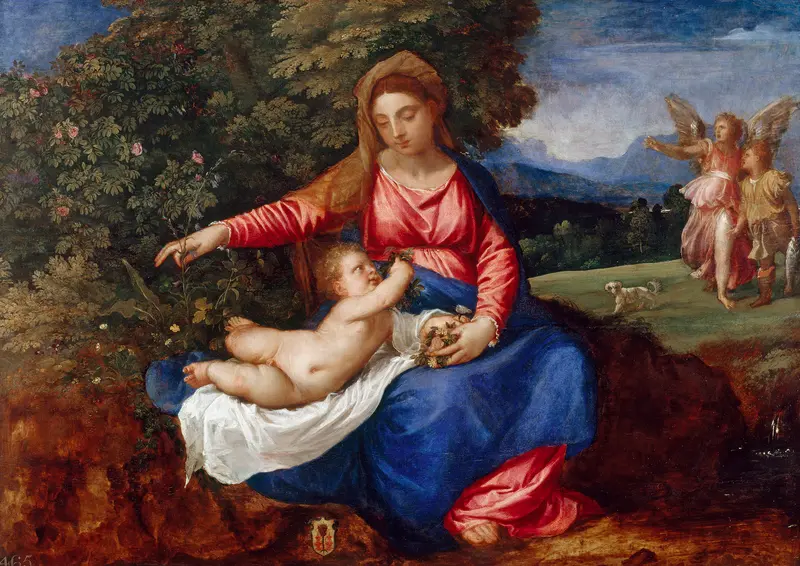
When Titian painted Angel in 1547, he was already the most sought-after artist in Venice, and yet the identity of the patron who commissioned this work remains a mystery. Unlike many of his religious commissions, Angel does not appear in the records of Venetian churches or noble inventories of the period. This has led to lively debate among scholars: was it intended as a private devotional image, or perhaps as a model for a larger altarpiece? The painting’s uncertain origins have only heightened its allure, drawing the attention of connoisseurs and historians alike. The angel in Angel is caught at the very instant of descent, one sandaled foot just brushing the earth, the other still poised in air.
Titian chooses not to depict a specific biblical event but rather the archetype of divine messenger, haloed in a golden light that radiates from the upper left. The angel’s hand, raised in gentle greeting, echoes the gestures in Fra Angelico’s Annunciations, yet Titian’s figure is more corporeal, the drapery swirling with a sense of motion and weight. The chain at the angel’s waist suggests both restraint and authority, while the intense gaze fixes the viewer, inviting contemplation of the boundary between the mortal and the divine. The physical journey of Angel is as enigmatic as its subject.
No contemporary documentation survives to confirm its early whereabouts, and it was not until the 19th century that the painting surfaced in a private Venetian collection, attributed to Titian by connoisseur consensus. Since then, it has passed through several hands, always admired for its bold handling of paint and luminous color, hallmarks of Titian’s late style. Today, Angel is housed in a major European museum, where it stands as a testament to the artist’s enduring fascination with the mysteries of faith and vision.