Titian’s Danaë in Naples: analysis and meaning
Danaë, the princess of Argos whom legend says her father shut in a tower, names this canvas, yet X-rays described by the National Gallery of Art in Washington show that Titian first planned a furnished room with a little dog and maidservants. The Naples Danaë (Danae in Italian), not the later Prado version, was painted in 1544–1545 for Cardinal Alessandro Farnese by Titian (c. 1488/90–1576), a painter Wikidata files under the High Renaissance, and belongs to the Museo di Capodimonte.
- A changed plan: the National Gallery of Art says X-rays show Titian’s first idea was a domestic interior, with a landscape seen through a window, a little dog and maidservants; Cupid replaced them, and the room became the tower of the legend.
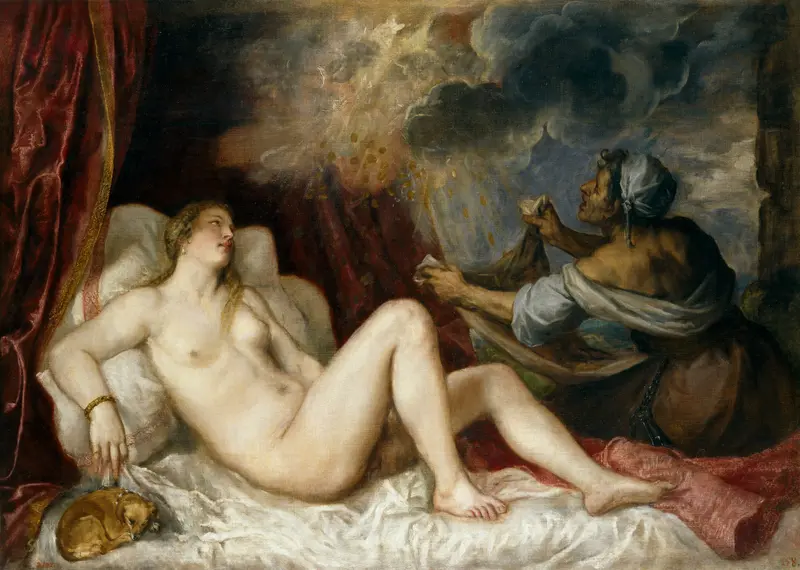
- Cupid’s reaction: a curtain is drawn back to show Danaë reclining in bed, about to receive Jupiter as a shower of gold coins; the National Gallery of Art contrasts her languorous pose and rapturous gaze with Cupid, who turns away at her feet.
- A Roman commission: Cardinal Alessandro Farnese, grandson of Pope Paul III, commissioned it; the painting was already underway in September 1544, when the papal legate Giovanni della Casa mentioned it in a letter, and was completed during Titian’s visit to Rome in 1545–1546.
- Naples, not Madrid: in the later Prado version, which Wikidata dates 1560–1565, Cupid gives way to an old nursemaid gathering the coins, a sleeping dog appears, and the white sheet over Danaë’s thigh is gone.
- A war-time journey: the National Gallery of Art says German troops looted the canvas for Field Marshal Hermann Göring during the Second World War; it was found in the Alt Aussee salt mine, taken to the Munich Central Collecting Point in 1945 and returned to the Italian government two years later.
Sources: National Gallery of Art, Washington: Titian’s Danaë from the Capodimonte Museum, Naples (brochure by David Alan Brown, 2014) · Wikidata Q14425558 (Danaë, Capodimonte, inv. Q 134) · Wikidata Q47551 (Titian, died 1576) · Wikidata Q14425553 (Danaë, Museo del Prado, P000425)
Questions and answers about the painting
What does Titian’s Danaë in Naples show, and what story is it?
It shows Danaë reclining in bed beneath a drawn-back curtain, about to receive Jupiter, who comes to her as a shower of gold coins, while Cupid turns away at her feet. In the myth, as the National Gallery of Art retells it, her father, the king of Argos, shut her in a tower to foil a prophecy that her son would kill him; Jupiter, lured by reports of her beauty, reached her anyway, and their son Perseus did eventually kill the king.
Where can you see Titian’s canvas for Cardinal Farnese?
At the Museo e Real Bosco di Capodimonte in Naples, under inventory number Q 134. The canvas belongs to the Farnese collection, which came to Naples through Charles of Bourbon, son of Elisabetta Farnese, and it travelled to Washington for a loan exhibition in 2014. Displays change, so check with the museum before a visit.
Source: National Gallery of Art, Washington: Titian’s Danaë from the Capodimonte Museum, Naples (brochure by David Alan Brown, 2014) · Wikidata Q14425558 (Danaë, Capodimonte, inv. Q 134)
How does the Naples Danaë differ from Titian’s Prado version?
In the Naples picture Cupid stands at Danaë’s feet, whereas in the Prado version, dated 1560–1565 in Wikidata, an old nursemaid greedily gathers the falling coins instead. The Prado painting also adds a sleeping dog and removes the white sheet that partly covers Danaë’s thigh in the Naples canvas. The Prado picture has its own page here: Danaë Receiving the Golden Rain.
Source: National Gallery of Art, Washington: Titian’s Danaë from the Capodimonte Museum, Naples (brochure by David Alan Brown, 2014) · Wikidata Q14425553 (Danaë, Museo del Prado, P000425)
When did Titian paint the Danaë for Cardinal Farnese?
Titian painted it in 1544–1545 for Cardinal Alessandro Farnese, according to the National Gallery of Art, which adds that it was already underway in September 1544 and was completed during his visit to Rome in 1545–1546, with delivery there at the end of 1545. Catalogues round the date differently: Wikidata gives 1545 for the Naples canvas.
Source: National Gallery of Art, Washington: Titian’s Danaë from the Capodimonte Museum, Naples (brochure by David Alan Brown, 2014) · Wikidata Q14425558 (Danaë, Capodimonte, inv. Q 134)
What did Michelangelo say about Titian’s Danaë?
According to Vasari, Michelangelo and Vasari visited Titian at the Belvedere in Rome, where he showed them a Danaë he had just painted, and they praised it. The National Gallery of Art, which takes this to be the Naples picture, adds that in Vasari’s 1568 edition Michelangelo praised Titian’s colour but complained, out of earshot, that Titian and the Venetians had never learned to draw.
Source: Giorgio Vasari, Lives of the Painters: Life of Titian (Gaston du C. de Vere translation, Fordham Internet History Sourcebooks) · National Gallery of Art, Washington: Titian’s Danaë from the Capodimonte Museum, Naples (brochure by David Alan Brown, 2014)
Is Titian’s painting at Capodimonte in the public domain?
Yes. Titian died in 1576, so his paintings are free of copyright everywhere. A faithful photograph of a public-domain painting adds no new copyright in the United States or the European Union, so you can download this image and use it in personal or commercial projects, such as posters, books, websites or teaching material. Public Domain Images for Commercial Use explains how.
Source: Wikidata Q47551 (Titian, died 1576) · Wikidata Q14425558 (Danaë, Capodimonte, inv. Q 134)