Danaë Receiving the Golden Rain: story and the Prado version
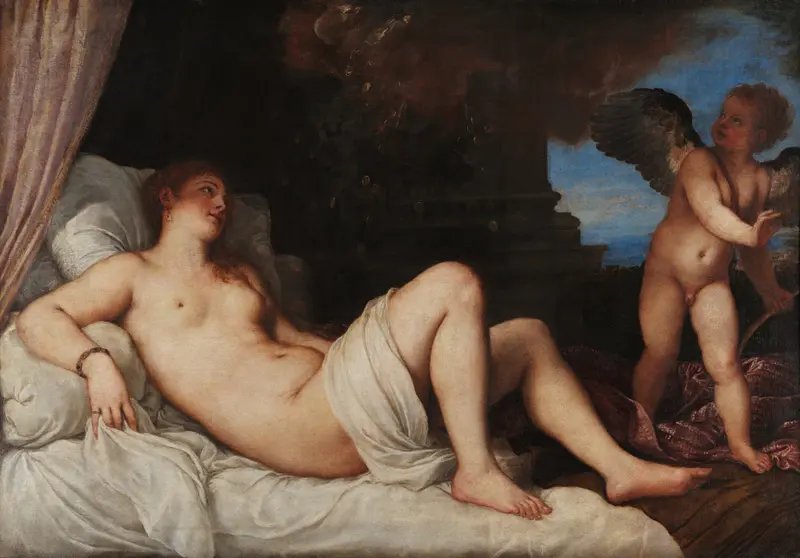
In the 1834 inventory of the Real Museo de Pinturas, this canvas is entry number 74: “Danae” by “El Ticiano”, a woman under a red canopy who receives the golden rain in her lap while an old woman at her feet eagerly gathers part of it. Danaë Receiving the Golden Rain is by Titian (c. 1488/90–1576), a painter Wikidata files under the High Renaissance and the Venetian school, is dated 1560–1565 and belongs to the Museo del Prado in Madrid.
- The story: Danaë, daughter of King Acrisius of Argos, was shut in a tower by her father; Jupiter reached her through a skylight in the form of a shower of gold, and she bore Perseus. The National Gallery in London tells it this way in its account of Titian’s poesie.
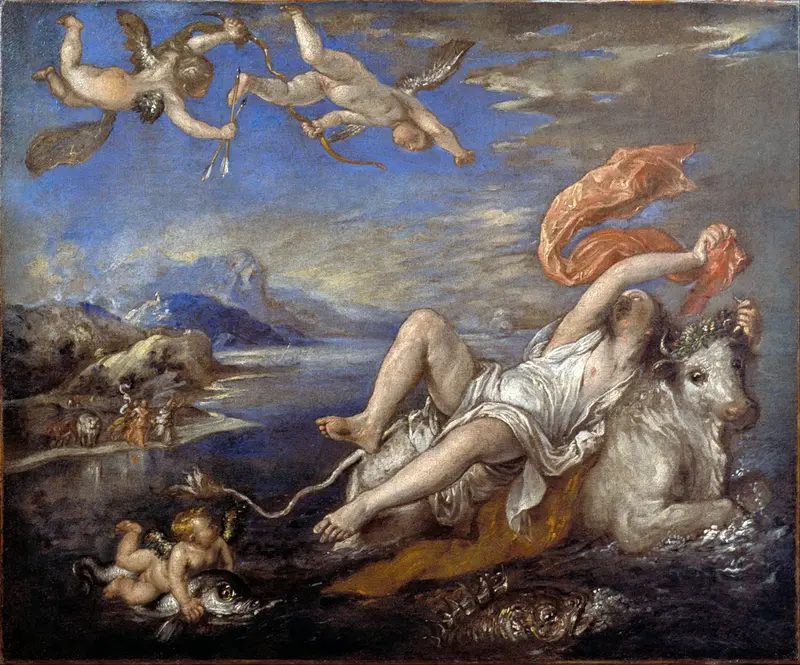
- A cycle for Philip II: the National Gallery says the six large mythological paintings Titian made for Prince Philip, drawn from Ovid and other classical sources, were produced from about 1551 to 1562, and names Danaë among the first. Wikidata, citing the Prado’s record, lists Philip II as an owner of this canvas in 1564.
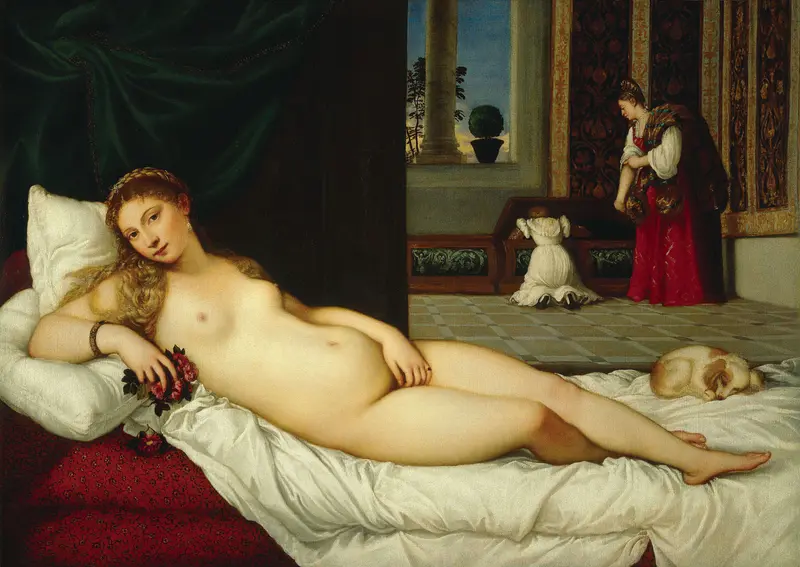
- Not the first Danaë: the National Gallery dates the Danaë in the Wellington Collection at Apsley House to probably 1554–6, while the Prado-derived Poder, patrimonio y cultura database record and Wikidata date this canvas to 1560–1565. CelestinaVisual notes that some of Titian’s versions leave out the old maidservant, who is present here.
- Before the museum: Wikidata, with the Prado’s record as its reference, names Giovanni Carlo Doria (1617–1625), Diego Velázquez (1629–1634) and Jerónimo de Villanueva (from 1634) as owners. In 1834 the museum’s inventory placed the picture in a “sala reservada”, a reserved room.
- Medium and size: oil on canvas, 129.8 × 181.2 cm, Prado inventory number P000425.
Sources: Poder, patrimonio y cultura en España: database record (Prado P000425, 1834 inventory) · Wikidata Q14425553 (the painting) · National Gallery, London: Titian’s poesie, the commission · CelestinaVisual.org: record of the painting (Prado P000425)
Questions and answers about the painting
What story does Titian’s Danaë Receiving the Golden Rain tell?
It tells the myth of Danaë, daughter of King Acrisius of Argos, whom her father shut in a tower because an oracle had said a grandson would kill him; Jupiter reached her through a skylight as a shower of gold, and she bore Perseus, as the National Gallery in London retells it. In the Prado canvas, the 1834 inventory describes the woman under a red canopy receiving the gold in her lap, and an old woman at her feet eagerly gathering part of the rain.
Source: National Gallery, London: Titian’s poesie, the commission · Poder, patrimonio y cultura en España: database record (Prado P000425, 1834 inventory)
Where is Titian’s Danaë with the old maidservant kept?
In Madrid, the Museo del Prado holds this canvas as inventory number P000425. Displays change, so check with the museum for the room before a visit. The painting is oil on canvas and measures 129.8 × 181.2 cm.
Source: Wikidata Q14425553 (the painting) · Wikimedia Commons: file page of the image (description, versions, date)
What other versions of Titian’s Danaë exist?
Besides this one, the Wikimedia Commons description of the image lists versions in Naples, Vienna and the Hermitage, and the National Gallery dates the Danaë at Apsley House to probably 1554–6, earlier than the 1560–1565 that the Prado-derived database record and Wikidata give for this canvas. The Naples picture has its own page: Danaë (Naples version). Each version is a separate painting.
Source: Wikimedia Commons: file page of the image (description, versions, date) · National Gallery, London: Titian’s poesie, the commission · Poder, patrimonio y cultura en España: database record (Prado P000425, 1834 inventory)
Who is the old woman beside Danaë in the Prado painting?
None of the sources we read gives the old woman a name. The 1834 inventory calls her simply an old woman (“una Vieja”) at Danaë’s feet, and CelestinaVisual describes her as a maidservant. The National Gallery’s retelling of the myth mentions no attendant.
Source: Poder, patrimonio y cultura en España: database record (Prado P000425, 1834 inventory) · CelestinaVisual.org: record of the painting (Prado P000425) · National Gallery, London: Titian’s poesie, the commission
When did Titian paint the Prado canvas?
Around 1560–1565, according to the date in the Poder, patrimonio y cultura database record for Prado P000425; Wikidata and Wikimedia Commons both give 1560–1565. That is later than the Apsley House Danaë, which the National Gallery dates to probably 1554–6. Titian died in 1576.
Source: Poder, patrimonio y cultura en España: database record (Prado P000425, 1834 inventory) · Wikidata Q14425553 (the painting) · Wikimedia Commons: file page of the image (description, versions, date) · National Gallery, London: Titian’s poesie, the commission
Is Titian’s painting in the Prado in the public domain?
Yes. Titian died in 1576, so his paintings are free of copyright everywhere. A faithful photograph of a public-domain work adds no new copyright in the United States or the European Union, so you can download this image and use it in personal or commercial projects, such as a print, a website or a book. Public Domain Images for Commercial Use explains how.
Source: Wikidata Q47551 (Titian) · Wikidata Q14425553 (the painting)