At Sea — History & Facts
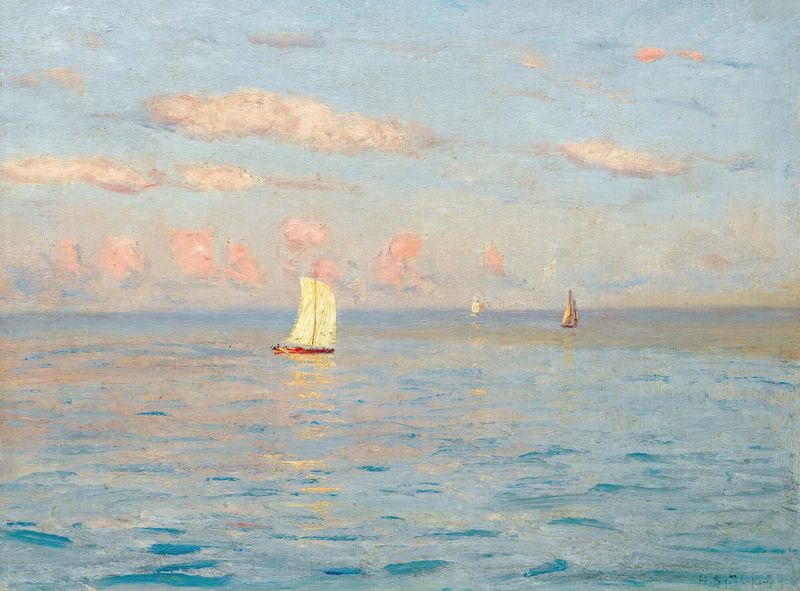
Can beauty exist without sorrow? In the work At Sea, a captivating tension between tranquility and melancholy unfolds, inviting viewers to ponder the intricate dance of creation and desolation. Look to the left, where the sea spills into the canvas, a vast expanse of indigo and azure. The waves are alive with movement, capturing the light in shimmering reflections that seem to quiver with energy. Notice how the horizon line blurs into the sky, a soft gradient of pastel hues, suggesting an impending change.
The gentle strokes of the brushwork convey both the power and fragility of nature, drawing the viewer into the delicate balance the artist meticulously crafted. Beneath the surface of this serene scene lies an emotional undercurrent. The tumultuous waves, while beautiful, hint at the unseen struggles of existence. There is a sense of isolation as the lone figure in a small boat confronts the vastness of the ocean, embodying the human experience of vulnerability amidst beauty.
Each ripple and shadow evokes a narrative of longing and resilience, reminding us that joy is often entwined with sorrow, capturing the duality of life. In 1918, the world was in the throes of change, politically and artistically, and At Sea emerged during a tumultuous period in Russia. Dubovskoy, who had witnessed the upheaval of the Russian Revolution, sought solace in nature, translating his complex emotions onto canvas. This painting reflects not only his personal journey but also the broader artistic movement that sought to embrace emotional depth in the face of uncertainty.