Cloud Study — History & Facts
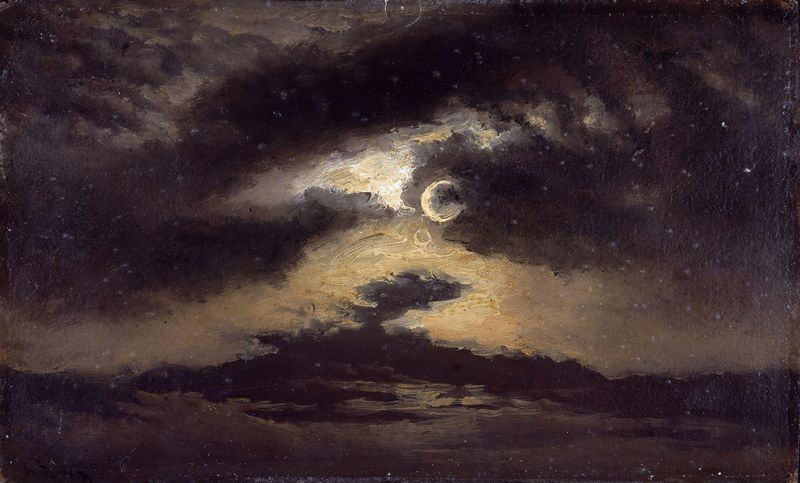
Could beauty survive in a century of chaos? The swirling clouds in Cloud Study evoke a sense of melancholy, whispering the stories of grief tucked within their luminous folds. Look to the top of the canvas, where billowing clouds dance against an ethereal sky, rendered in delicate strokes of white and grey. The artist employs a subtle gradation of blues, creating an atmospheric depth that draws the viewer's eye upward, inviting a contemplation of the infinite. The harmony of colors elicits both tranquility and unease, as if the clouds themselves are engaged in a silent conversation, reflecting the tumult of human emotions beneath. Within this serene panorama rests an underlying tension; the clouds, while beautiful, hint at the storm that may be approaching.
Each brushstroke conveys an emotional weight, layering softness with the potential for chaos. The juxtaposition of light and shadow invites introspection, suggesting that even in moments of beauty, there is an awareness of loss and longing interwoven throughout the scene. In 1838, Knud Baade was living in Norway, a time when Romanticism was shifting the landscape of art. He was grappling with the natural world's ferocity, reflecting the turbulence of his own life and the broader European unrest.
As artists sought to capture emotion over mere representation, Baade’s work emerged from this era of introspection, where nature served as both muse and metaphor for human experience, embodying the personal and collective grief of his time.