Cloud Study — History & Facts
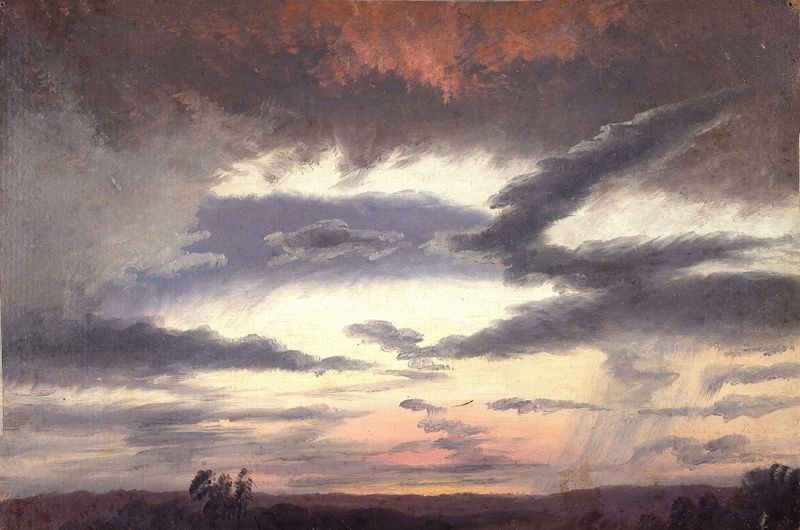
In the delicate embrace of nature’s transience, we find a poignant reminder of fragility and transformation. Moments captured on canvas can evoke the fleeting beauty of life, leaving us to ponder our existence within this ever-changing world. Look to the upper part of Cloud Study to witness a symphony of colors blending seamlessly together. The soft whites and grays of the clouds dance across the sky, infused with hints of violet and gold that suggest the sun's hidden warmth.
Notice how Baade’s brushwork captures the ethereal quality of light as it filters through the vaporous forms, creating a sense of movement and depth. The sweeping strokes invite your gaze to drift, inviting contemplation of the celestial majesty above. Within this serene panorama lies a subtle tension between permanence and impermanence. The clouds, while visually grand, represent a fleeting moment — a snapshot of a larger, ever-shifting sky.
This juxtaposition mirrors the human experience, where we often cling to transient moments of beauty despite their inevitable dissolution. The quietude of the scene juxtaposes our restless nature, urging us to recognize the value of each ephemeral breath. In 1837, Baade created this work during a time of artistic exploration in Europe, marked by the rise of Romanticism. Living in Norway, he immersed himself in the natural world, seeking to portray its emotional resonance.
This period in his life was characterized by a deep connection to the landscape, as he worked to express the complexities of nature and the human spirit, marking a significant evolution in his artistic journey.