December Greys — History & Facts
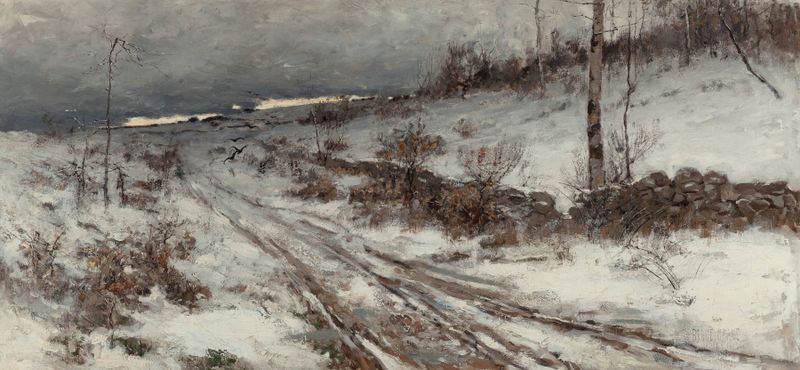
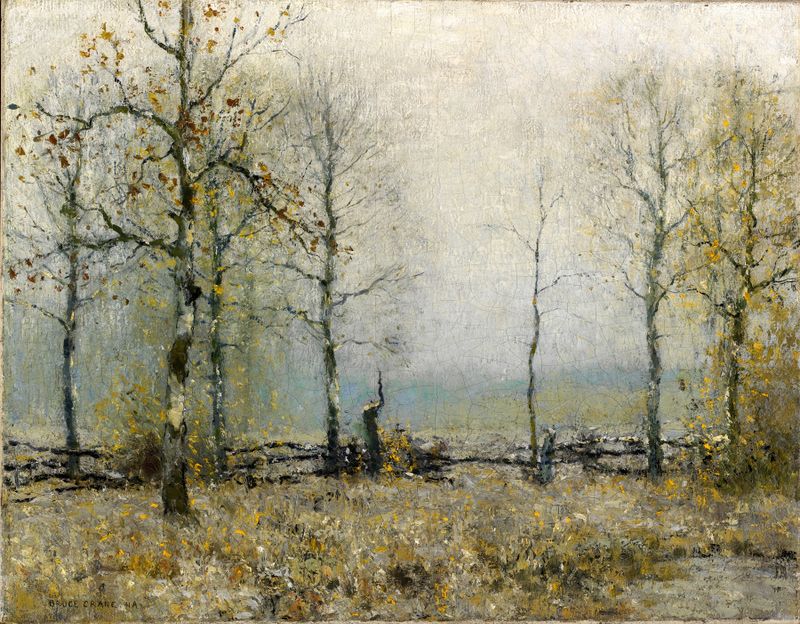
In the quiet corners of existence, where decay intertwines with beauty, a landscape speaks softly yet profoundly. Look to the center of the canvas where a muted horizon line divides the somber, overcast sky from the barren earth below. The palette is dominated by a chorus of grays, deep blues, and whispers of browns, evoking the chill and stillness of winter. Notice how the skeletal branches of the trees reach outwards, their gnarled forms creating an intricate web against the soft, diffused light that filters through the clouds, suggesting both resignation and resilience in their starkness. Crane's exploration of decay shines through in the details—the withering grass, the lifeless branches, and the heavy atmosphere that envelops the scene.
Each element carries a weight, a reminder of the inevitability of change and the beauty embedded within it. The monochromatic scheme emphasizes a certain melancholy, yet there is also a whisper of hope lingering in the stillness, as if the land is patiently awaiting the return of life. In 1921, Crane was immersed in the American artistic scene, influenced by the natural landscapes of New England. This work reflects a period of introspection, both personally and artistically, as the nation grappled with the aftermath of World War I.
The painting captures a moment when the world outside was shifting, yet within the canvas, the stillness invites contemplation and connection to the raw, unfiltered essence of nature.