
Folk fetching water in Upper Egypt — History & Facts
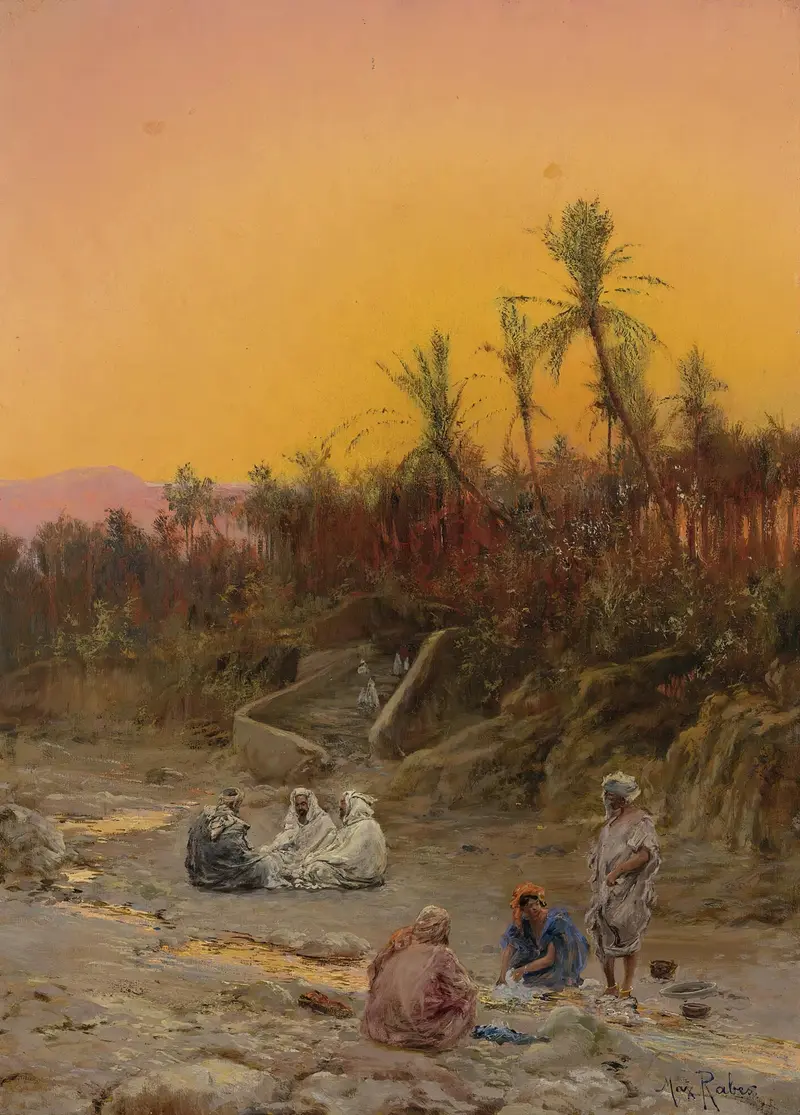
Did the painter know this moment would outlive them? In Folk fetching water in Upper Egypt, the vivid interplay of color captures the essence of a world that flows beyond time, inviting us to reflect on the significance of daily rituals. Focus on the radiant ochres and deep indigos that dominate the canvas. The earthiness of the landscape contrasts with the shimmering blues of the water, drawing the viewer's gaze towards the figures who labor with purpose. Notice how the warm sunlight bathes the scene, highlighting the textured garments of the women, while the shadows add depth to the surrounding environment.
Each brushstroke evokes the rhythm of life, painting a portrait of resilience and community. Within this tapestry, there exists a poignant duality: the simplicity of fetching water juxtaposed against the profound need for sustenance and connection. The women's stoic expressions speak to their strength, yet their communal effort hints at the vulnerability of reliance on nature. The painting also reflects a deep cultural legacy, as these moments of daily life resonate with the history of human civilization itself, where even the most mundane acts are woven into the fabric of existence. Max Friedrich Rabes created this work in 1899 while living in Germany, though he was inspired by travels and experiences in Egypt.
At that time, European artists were increasingly drawn to exotic locales, driven by a fascination with diverse cultures and landscapes. This painting emerged during a period of significant artistic exploration, as Rabes sought to capture the essence of the places he encountered, bridging the gap between the known and the unfamiliar through his brush.
More Artworks by Max Friedrich Rabes

More Genre Scene Art

Banquet of the Officers of the St George Civic Guard
Frans Hals

Rembrandt and Saskia in the Scene of the Prodigal Son
Rembrandt van Rijn

Bal du moulin de la Galette
Pierre-Auguste Renoir

Quadrille at the Moulin Rouge
Henri de Toulouse-Lautrec

A Burial at Ornans
Gustave Courbet

When Will You Marry?
Paul Gauguin