Hut in the Tatra Mountains — History & Facts
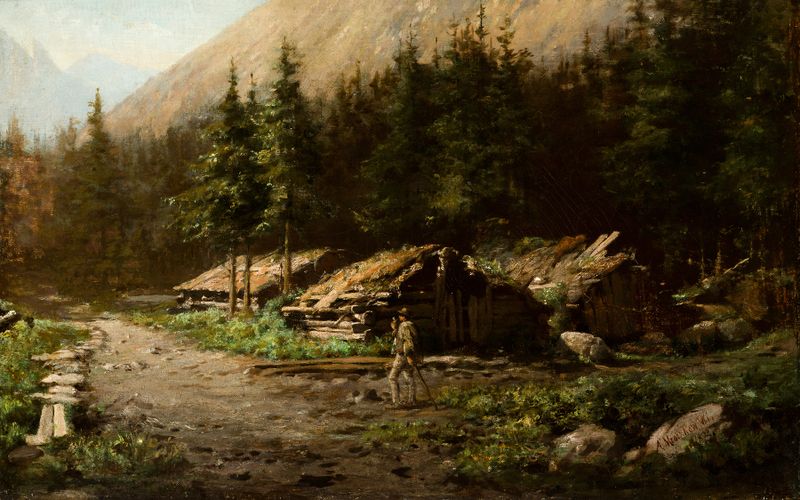
Could beauty survive in a century of chaos? The question lingers in the stillness of this mountainous scene, whispering of solitude and the passage of time. Look to the foreground, where a humble hut nestles against the rugged Tatra Mountains. Mroczkowski’s brushwork captures the texture of the wooden structure, its earthy browns harmonizing with the surrounding greens and whites. The stark contrast between the hut and the looming peaks beckons the viewer’s gaze upward, where the sky unfurls a tapestry of soft blues and grays.
Each layer of paint seems to celebrate the natural world, while the sweeping lines of the mountains evoke both majesty and melancholy. As you delve deeper, notice the play of light across the landscape—fingers of sunlight reach toward the hut, casting long shadows that suggest the weight of isolation. This tension between warmth and emptiness speaks to the human longing for connection amidst nature's vastness. The hut stands as a symbol of resilience, yet its solitude raises questions about the transient nature of beauty in a world marked by chaos and uncertainty. In 1899, Mroczkowski was immersed in the artistic currents of Poland, drawing inspiration from the romanticism of his landscape predecessors.
His works often reflect the interplay between human presence and the sublime qualities of nature, a response to the changing social fabric of Europe at the time. As industrialization began to reshape the landscape, the artist sought to capture the haunting beauty of untouched places, as seen in this evocative piece.