
Judit with the Head of Holofernes — History & Facts
When Judit with the Head of Holofernes left the workshop of Sandro Botticelli in 1498, Florence was still reeling from the execution of the fiery preacher Savonarola, and the city’s appetite for images of virtue triumphing over tyranny was at its peak. This painting, created in the artist’s later years, stands out as one of the rare treatments of the Judith story by a master of the Renaissance who was more often drawn to mythological themes. Unlike the many versions by his contemporaries, Botticelli’s Judith is not caught in the act of violence but in the aftermath, a moment of calm after the storm. Judith, the biblical widow, has just beheaded the Assyrian general Holofernes to save her besieged city.
Botticelli chooses to show her striding away from the enemy camp, sword in one hand, Holofernes’s head dangling from the other, her servant following behind. The golden chain around her neck and the fine drapery of her gown signal both her virtue and her nobility, while her downcast eyes and composed expression suggest a quiet resolve rather than triumph. The light falls softly on her face, accentuating her serenity in contrast to the horror of her deed—a striking difference from the visceral drama of Artemisia Gentileschi’s later Judith Slaying Holofernes.
In Botticelli’s hands, Judith becomes an emblem of moral courage, her beauty undiminished by the violence she has committed. The precise origins of this painting remain uncertain, as the original patron is unknown and the medium itself is still debated among scholars. What is clear is that Judit with the Head of Holofernes marks a late moment in Botticelli’s career, when his style had grown more linear and restrained, reflecting the somber mood of Florence in the 1490s. The work has passed through several collections over the centuries, often overshadowed by Botticelli’s more famous mythological scenes, and today it is recognized as a rare example of his engagement with Old Testament heroines.
Its survival offers a glimpse into both the anxieties and aspirations of Renaissance Florence, and the enduring appeal of Judith’s story as a symbol of hope in dark times.
More Artworks by Sandro Botticelli

Virgin and Child
Sandro Botticelli

Madonna and Child and the Young St John the Baptist
Sandro Botticelli

Madonna and Child with six angels and Saint John the Baptist as Child
Sandro Botticelli

Adoration of the Magi
Sandro Botticelli

Virgin and Child with the Young Saint John the Baptist
Sandro Botticelli
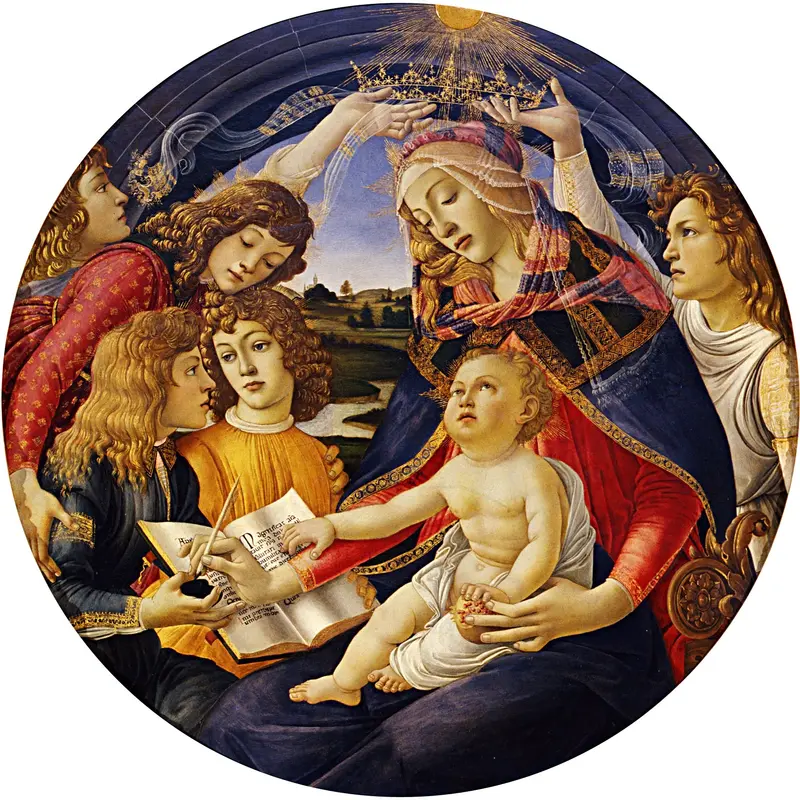
Madonna of the Magnificat
Sandro Botticelli

Calumny of Apelles
Sandro Botticelli

Portrait of a young man holding a roundel
Sandro Botticelli

The Trinity with Saint Mary Magdalene and Saint John the Baptist, the Archangel Raphael and Tobias
Sandro Botticelli

Idealized Portrait of a Lady (Portrait of Simonetta Vespucci as Nymph)
Sandro Botticelli





