
Calumny of Apelles — History & Facts
A group of nine figures animates the centre and right of an ornate palace interior, with marble arches and gilded reliefs framing the scene. On the left, a nude woman stands upright, raising her right hand to the sky and pointing upward, her gaze directed heavenward. Beside her, a cloaked figure in black bends forward, arms crossed and head bowed, the drapery pooling at her feet.
In the foreground, a half-naked youth collapses to the ground, his arms lifted defensively as he is seized by the hair by a woman in white and blue, who strides forward with a flaming torch in her left hand. Behind her, another woman in pink and gold leans in, arranging the hair of the torchbearer, while a dark-bearded man in black grips her arm and gestures toward the throne. At the right, a crowned king sits on a raised throne, his ears elongated like those of a donkey, as two richly dressed women whisper into them, one on each side, their hands cupped to his head.
The king's hand extends toward the group, but his downcast eyes do not meet the scene before him. The architecture is lavish, with niches containing classical statues and panels decorated with golden mythological scenes, while the pale blue sky and distant sea are visible through the arches. The light falls evenly across the figures, highlighting the bright, flowing garments and the smooth, pale skin, especially of the central women and the fallen youth.
The composition leads from left to right, guiding the viewer’s gaze from the serene Truth, through the tumult of accusation, to the enthroned king. Brushwork is precise and linear, with crisp outlines defining each figure and garment, and the surface appears smooth, with little visible texture. Sandro Botticelli painted Calumny of Apelles in the 1490s, drawing on a description by Lucian of a lost work by the ancient Greek painter Apelles. The subject was admired in Renaissance Italy, and Botticelli’s version interprets Lucian’s account, which describes Midas with large ears on a throne, surrounded by allegorical figures including Ignorance, Suspicion, Slander, Fraud, Envy, and others.
The figures in the painting correspond to Lucian’s description: Truth points to heaven; Repentance is cloaked in black; the victim is dragged by Calumny, who holds a torch, as Fraud arranges her hair; Envy, bearded and hooded, gestures toward the king, who is flanked by Ignorance and Suspicion. The painting belongs to the Early Renaissance movement and is considered a mythological allegory, with each character personifying a vice or virtue.
Sources: Uffizi Gallery, record 00285580 · Wikidata Q1217187 · Wikipedia: Calumny of Apelles · Image source (Wikimedia Commons)
More Artworks by Sandro Botticelli

Virgin and Child
Sandro Botticelli

Madonna and Child and the Young St John the Baptist
Sandro Botticelli

Madonna and Child with six angels and Saint John the Baptist as Child
Sandro Botticelli

Adoration of the Magi
Sandro Botticelli

Virgin and Child with the Young Saint John the Baptist
Sandro Botticelli
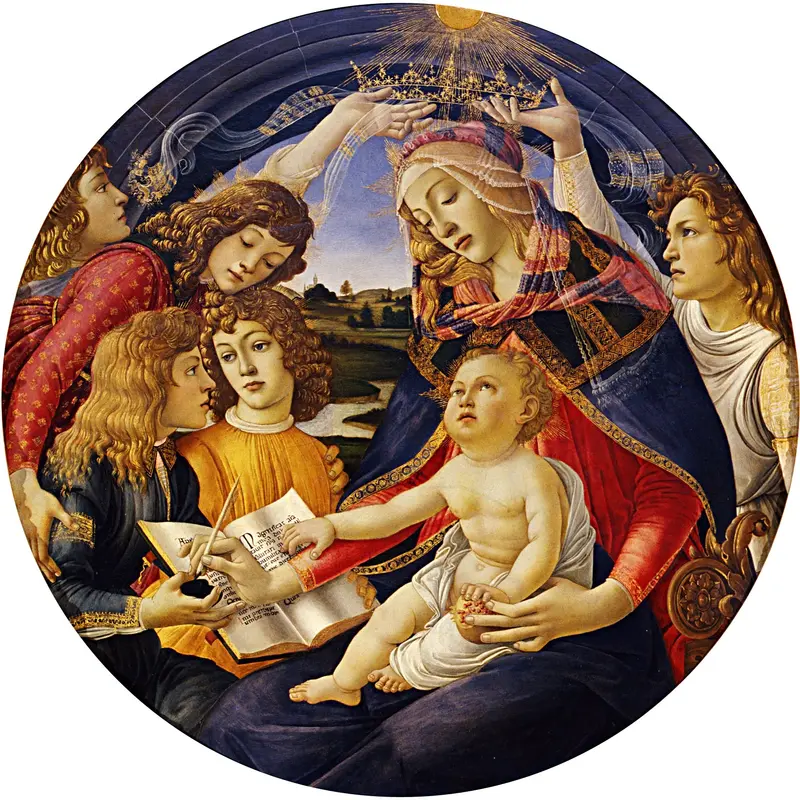
Madonna of the Magnificat
Sandro Botticelli

Portrait of a young man holding a roundel
Sandro Botticelli

The Trinity with Saint Mary Magdalene and Saint John the Baptist, the Archangel Raphael and Tobias
Sandro Botticelli

Idealized Portrait of a Lady (Portrait of Simonetta Vespucci as Nymph)
Sandro Botticelli

Annunciation
Sandro Botticelli





