
Kruisiging — History & Facts
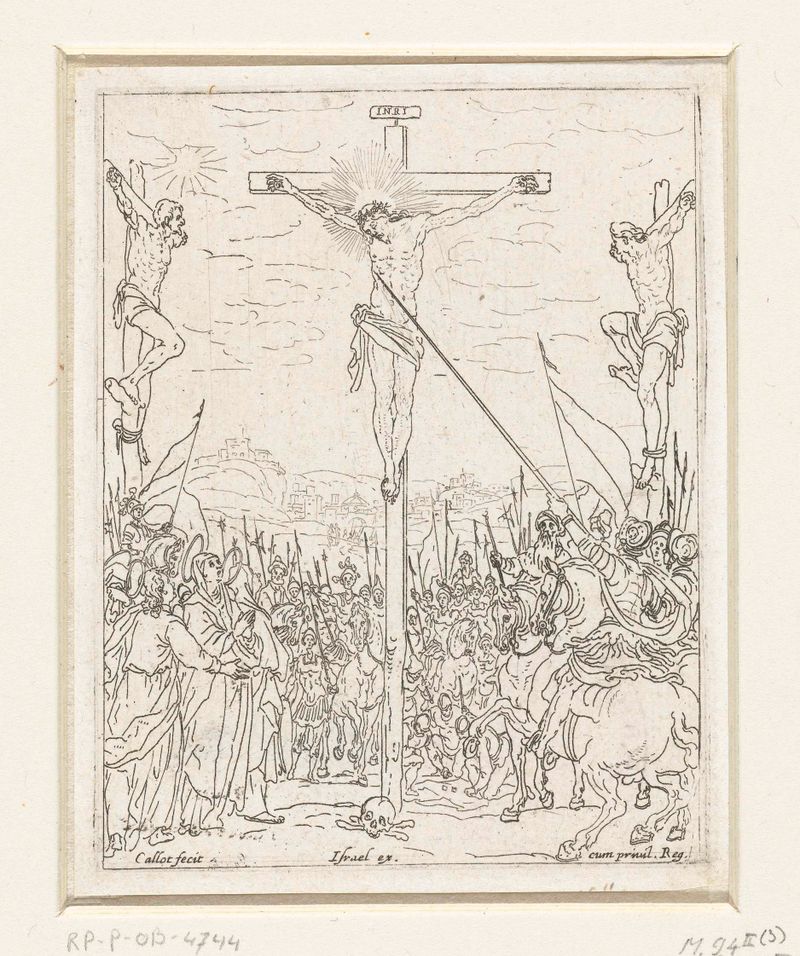
Where does light end, and longing begin? In the chiaroscuro of Jacques Callot's Kruisiging, we witness a visceral transformation—a moment suspended between despair and grace. Focus first on the figure of Christ, crucified at the center, where the light converges to reveal the anguish of his body. Notice how the shadows deepen around him, contrasting the somber tones that envelop the scene. The sky above swirls with dark clouds, their tumultuous forms echoing the emotional tension of the moment.
Callot's masterful use of etching captures intricate details, from the anguish etched upon the faces of onlookers to the haunting gestures that speak of both mourning and reverence. Delve deeper into the poignant contrasts within the artwork. The stark division between light and shadow serves not just to illuminate despair but also hints at the flicker of hope that often accompanies sorrow. Observe the figures gathered below, their expressions taut with grief; yet, among them lies a glimmer of devotion, suggesting a profound transformation within the human spirit.
Each character, from the gaunt soldier to the anguished Mary, embodies a spectrum of emotions, revealing the complex layers of faith and suffering. Created between 1608 and 1611, Kruisiging emerged during a period of significant artistic evolution for Callot, who was influenced by the Counter-Reformation's fervent spirituality. Residing in Nancy, he sought to elevate emotive storytelling through art, employing the medium of etching to reach a wider audience. This work reflects the tumultuous socio-political climate of the time, where themes of sacrifice and redemption resonated deeply within European consciousness.
More Artworks by Jacques Callot
Browse all →
Titelprent voor de prentreeks 'De kleine apostelen' (Het martelaarschap van de apostelen)
Jacques Callot
Kruisiging
Jacques Callot

De doortocht door de Rode Zee
Jacques Callot

De verloren zoon als zwijnenhoeder
Jacques Callot

Annunciatie
Jacques Callot
Village Fight
Jacques Callot

Titelprent voor prentreeks 'Het leven van Maria'
Jacques Callot
Titelprent voor de prentreeks 'De grote apostelen' (Christus, Maria en de apostelen)
Jacques Callot

Christus aan het volk getoond (Ecce homo)
Jacques Callot
Portret van de Heilige Franciscus
Jacques Callot
More Religious Art
Browse all →
The Return of the Prodigal Son
Rembrandt van Rijn

The Garden of Earthly Delights
El Bosco

Count Orgaz’ funeral
El Greco

The Hundred Guilder Print: the central piece with Christ preaching, the plate arched
Rembrandt van Rijn

The Descent from the Cross
Rogier van der Weyden

The return of the prodigal son
Rembrandt van Rijn