
Landscape With Cows — History & Facts
In the realm of nature, where the ephemeral meets the eternal, a stillness punctuates the vibrant life unfolding in Landscape With Cows. This painting invites us to confront not just the beauty of the scene but the underlying truths of existence and mortality woven within it. Look to the foreground, where gentle hills cradle a cluster of cows grazing peacefully, their forms rendered in soft browns and whites. Notice how the light dances across the grassy landscape, illuminating the textures of the earth and the delicate clouds drifting above.
Dupré’s brushwork creates a feeling of movement, as if the natural world breathes, with the warm light casting long shadows that hint at the passage of time. The color palette, rich yet muted, evokes a sense of nostalgia, drawing the viewer into a moment that feels both idyllic and fleeting. As you explore the deeper layers of this artwork, consider the juxtaposition of the serene pastoral scene against the concept of mortality. The cows, symbols of pastoral life, are serene yet remind us of the cycle of life, echoing the transience of all living things.
The expanse of the landscape serves as a metaphor for time itself—vast, beautiful, and ultimately finite. Each blade of grass and each cloud overhead carries a weight of existence, inviting contemplation on our place in the natural world. Created in the mid-19th century, during an era marked by rapid industrialization and a growing disconnect from nature, the artist captured a moment of tranquility amidst societal change. Jules Dupré painted Landscape With Cows when the Romantic movement was flourishing, emphasizing the beauty of the natural landscape as a refuge from the modern world.
His work reflects a longing for simplicity and a connection to the earth, capturing both the allure and the impermanence of life.
More Artworks by Jules Dupré
Browse all →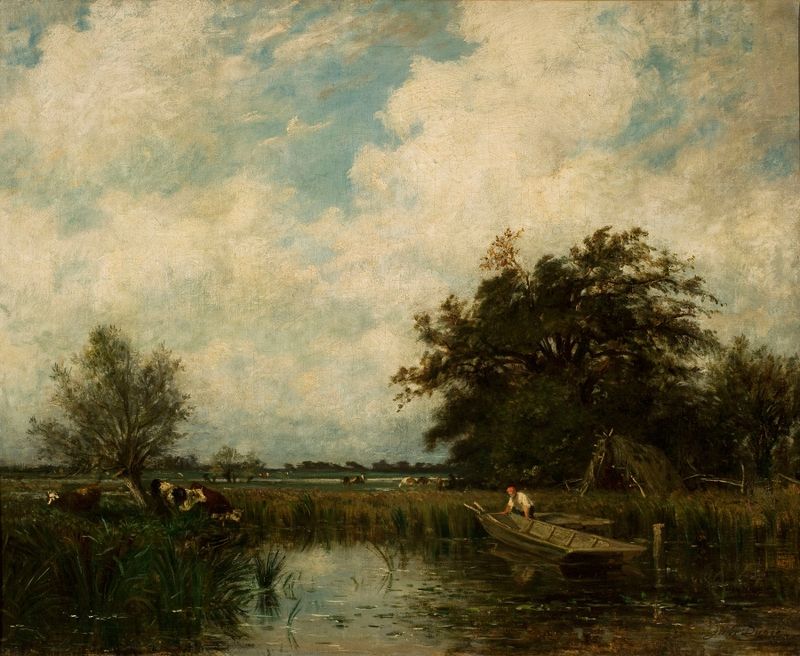
Landscape with a pond
Jules Dupré

The Cottage by the Roadside, Stormy Sky
Jules Dupré
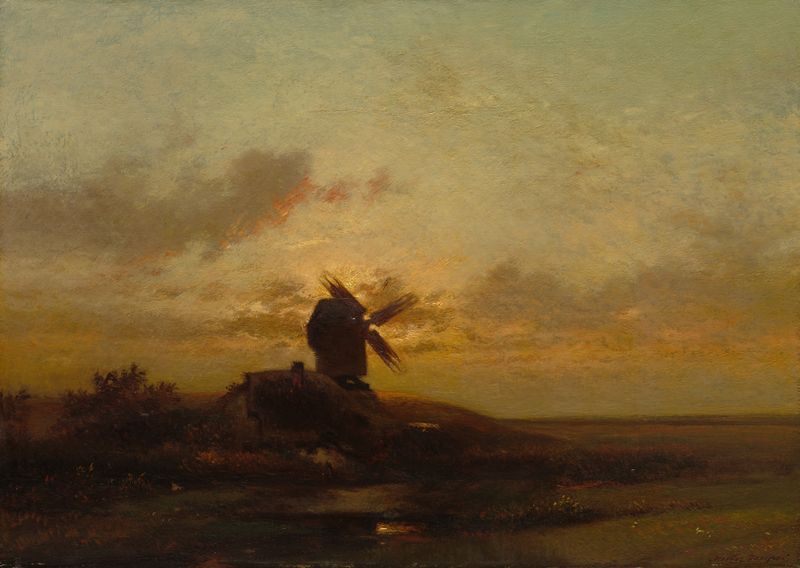
The Windmill
Jules Dupré

The Estuary Farm
Jules Dupré

Fontainebleau Oaks
Jules Dupré

Village Scene, Sunset
Jules Dupré

Barks Fleeing Before the Storm
Jules Dupré

Cows Crossing a Ford
Jules Dupré

The Old Oak
Jules Dupré

Weidelandschaft im Limousin
Jules Dupré





