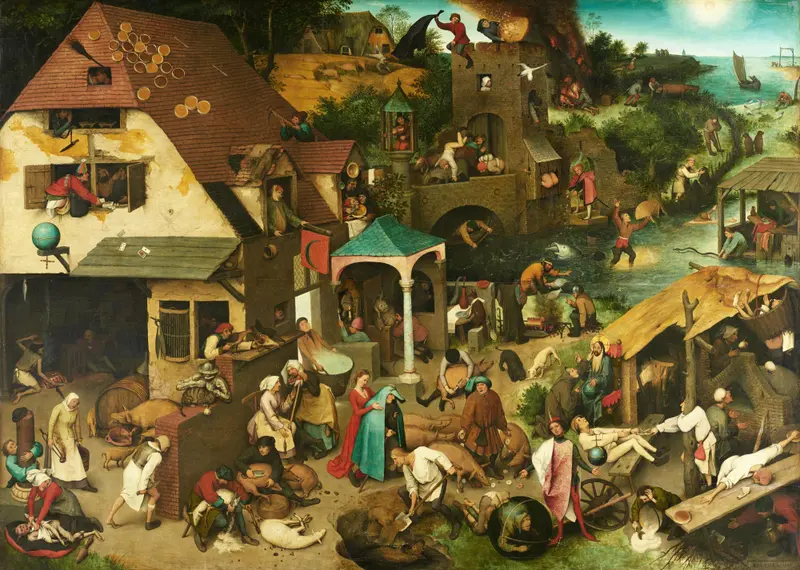
Lazarillo de Tormes and His Blind Master — History & Facts
What grips the viewer first in Lazarillo de Tormes and His Blind Master is the charged silence between the two figures: a boy and an old man, locked in a moment of wary intimacy. The boy’s gaze, quick and sidelong, seems to measure the blind man’s closed eyes and the heavy, gnarled hands clutching a bright green jug. Light pools on the jug and the boy’s cheek, drawing the eye to this axis of need and cunning—the boy’s intent, the man’s guardedness.
The brushwork is loose and dark, the background receding into shadow, so that every detail—the ragged sleeve, the boy’s red tunic, the old man’s patched headscarf—feels deliberate, as if the painter wants us to sense the tension of survival in every fold and glance. This painting belongs to a tradition that flourished in nineteenth-century Europe, when artists like Augustin Théodule Ribot drew on the gritty realism of Spanish Golden Age painters to tell stories of the poor and marginalized. The subject—a scene from the classic Spanish picaresque novel—was a favorite for those who sought to dignify humble life with the drama of oil and canvas. Works like this were rarely grand commissions; they were more often painted for collectors drawn to the raw humanity of everyday struggle, or for salons eager to see the old masters’ shadows revived in modern hands.
Taken on 11 November 2021 and now in a private collection, this particular work survives as a testament to that enduring fascination with the sharp edge of poverty and wit. Look again at the boy’s face and the blind man’s grip: the story is all there, in the play of light and the weight of a single green jug.
More Artworks by Augustin Théodule Ribot

The Scullion
Augustin Théodule Ribot

The Artist's Daughter
Augustin Théodule Ribot
The oyster and the Litigant's
Augustin Théodule Ribot

The philosophers
Augustin Théodule Ribot

Singers
Augustin Théodule Ribot

Oyster and timbale
Augustin Théodule Ribot
Portrait of the artist's mother
Augustin Théodule Ribot

Three old jews
Augustin Théodule Ribot

' Landscape ', known as ' La Maison de Corot in Ville-d'Avray '
Augustin Théodule Ribot
La recette du cuisinier
Augustin Théodule Ribot