
Madonna and Child — History & Facts
Mary sits in the foreground, her head gently inclined toward the Christ Child who rests on her lap. Her right hand supports the Child’s back, while her left hand delicately cradles his legs, creating a sense of protective intimacy between mother and son. Mary’s expression is serene and contemplative, her eyes lowered and lips softly closed, while the Child’s face is round and animated, his gaze lively and searching.
A thin, golden aureola encircles Mary’s head, its rays rendered with fine, precise lines that catch the light and set her apart from the earthly setting. She wears a deep green mantle lined with gold over a rich red dress, the folds of her garments painted with smooth, controlled brushstrokes that emphasize the volume and weight of the fabric. Behind the figures, a pair of dark columns rise on either side, framing the scene and leading the eye toward a distant landscape of slender trees and a pale blue sky.
Soft light falls from the left, illuminating Mary’s face and the Child’s body, and casting gentle shadows that model their forms with subtlety. The composition is tightly focused on the two central figures, with their forms filling most of the panel and only a narrow strip of landscape visible beyond the columns. The paint surface reveals smooth transitions between light and shadow, especially in the modeling of flesh and fabric, while the outlines remain crisp and clear. Madonna and Child was created by Sandro Botticelli in 1470.
The painting forms part of the Andrew W. Mellon collection, according to the National Gallery of Art.
Sources: National Gallery of Art, record 1937.1.21 · Wikidata Q20173966
More Artworks by Sandro Botticelli

Virgin and Child
Sandro Botticelli

Madonna and Child and the Young St John the Baptist
Sandro Botticelli

Madonna and Child with six angels and Saint John the Baptist as Child
Sandro Botticelli

Adoration of the Magi
Sandro Botticelli

Virgin and Child with the Young Saint John the Baptist
Sandro Botticelli
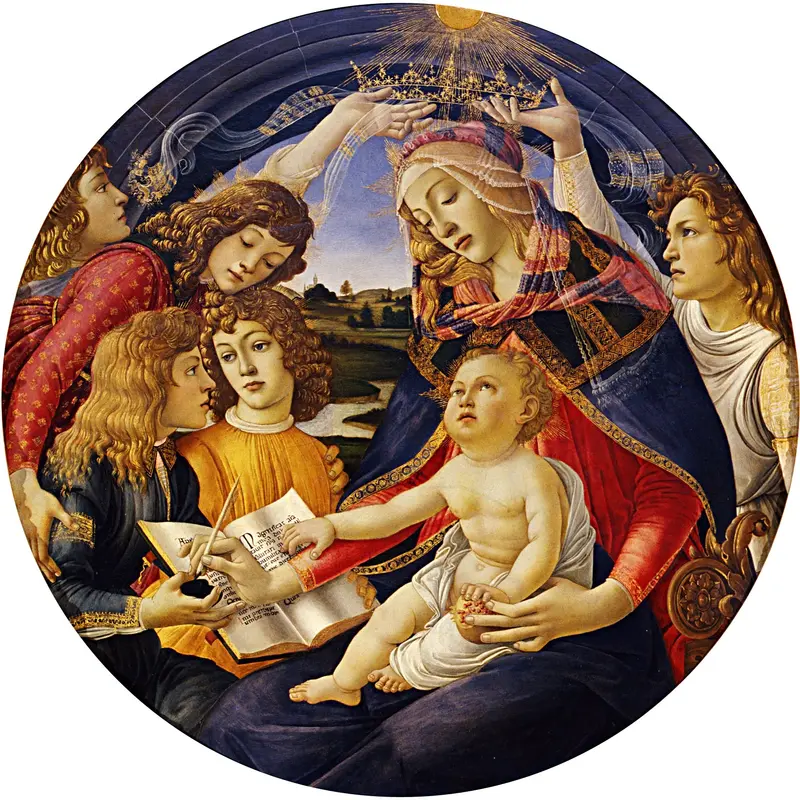
Madonna of the Magnificat
Sandro Botticelli
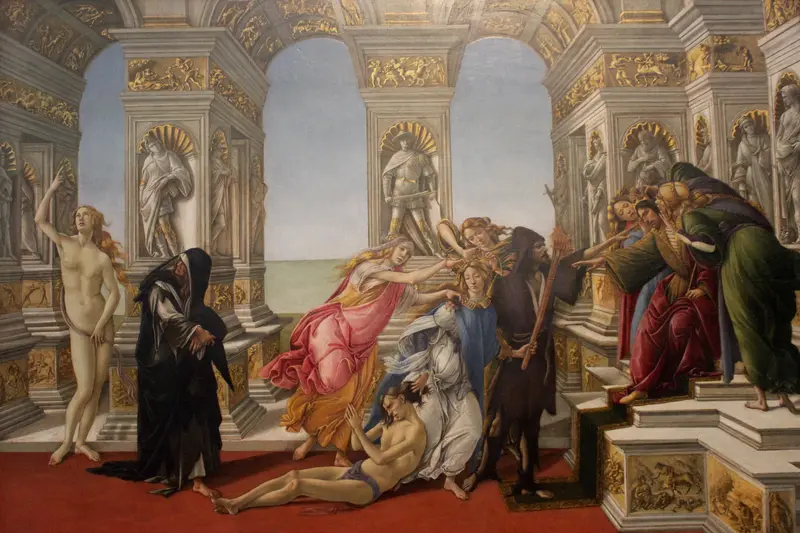
Calumny of Apelles
Sandro Botticelli

Portrait of a young man holding a roundel
Sandro Botticelli

The Trinity with Saint Mary Magdalene and Saint John the Baptist, the Archangel Raphael and Tobias
Sandro Botticelli

Idealized Portrait of a Lady (Portrait of Simonetta Vespucci as Nymph)
Sandro Botticelli





