Ola Bull — History & Facts
Few portraits have sparked as much curiosity as Ola Bull by Nils Dardel, owing largely to the enigmatic connection between the Swedish artist and the legendary Norwegian violinist Ole Bull. While the precise date and circumstances of the painting’s creation remain uncertain, it is the very subject—Bull, a 19th-century virtuoso whose performances electrified Europe—that anchors the work in a swirl of artistic and musical history. The painting stands out in Dardel’s oeuvre for its focus on a real historical figure celebrated far beyond Scandinavia, inviting speculation about the artist’s intentions and relationship to his subject. In the composition, Nils Dardel captures Bull at a moment of rapt concentration, bow poised, eyes fixed beyond the canvas as if listening to music only he can hear.
The background, likely rendered in Dardel’s signature bold palette, may dissolve into abstract forms, emphasizing the intensity of Bull’s presence and the almost otherworldly aura that contemporary accounts attributed to his performances. The violin, cradled with care, becomes not just an instrument but an extension of Bull’s identity, echoing the way Edvard Munch in his portraits often fused sitter and setting to express inner life. Every detail—the tilt of the head, the tension in the hands—serves to underline the legend of Bull as both musician and myth. The journey of Ola Bull as an object is cloaked in some mystery.
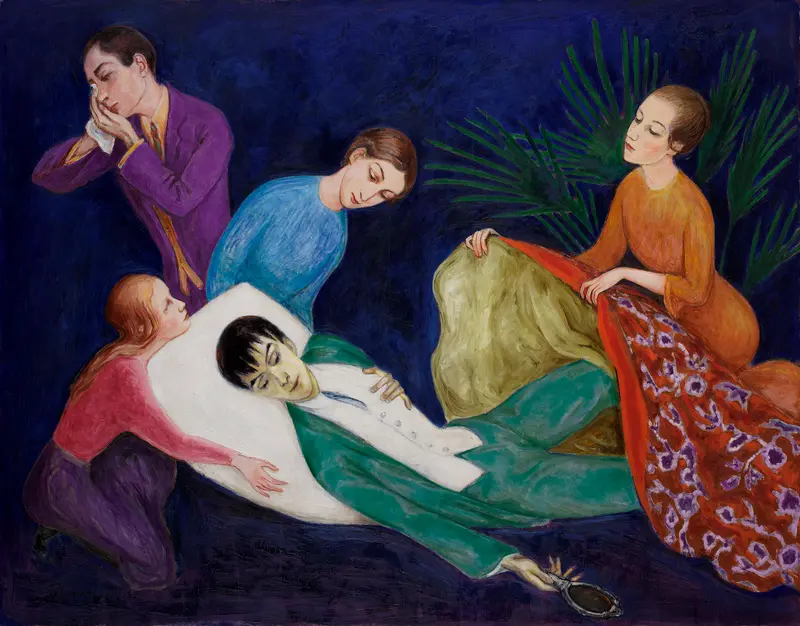
Its provenance is not fully documented, and scholars continue to debate whether it was a commission, a tribute, or a personal project by Nils Dardel. Unlike many of Dardel’s better-known works, such as The Dying Dandy, this portrait does not appear in major retrospectives or catalogues, suggesting it may reside in a private collection or remain tucked away in a lesser-known institution. The painting’s uncertain status only adds to its allure, representing a fascinating intersection of Nordic art and music at the turn of the 20th century, and hinting at the broader cultural ambitions that marked Dardel’s career.