Portici Landscape — History & Facts
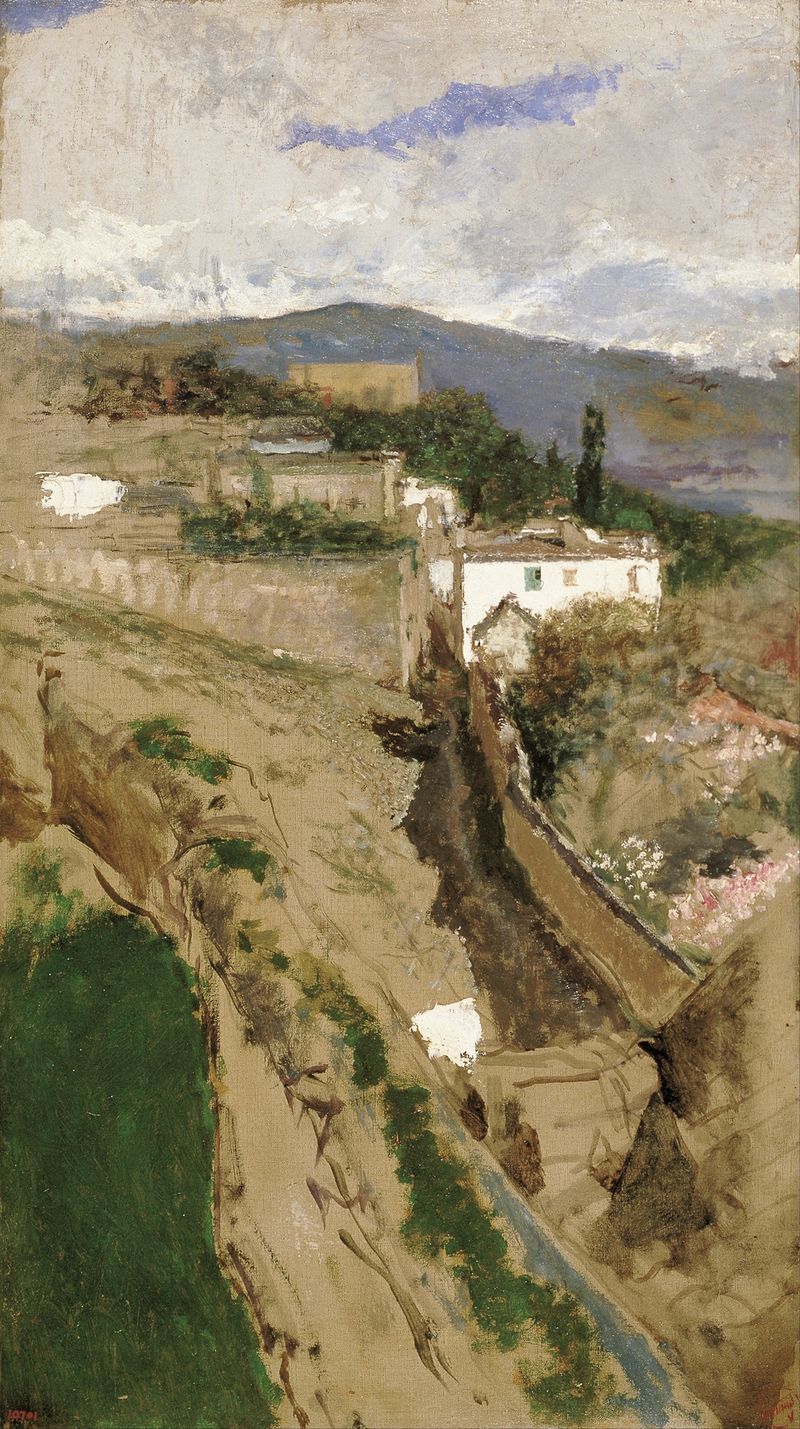
Where does light end, and longing begin? In the canvas before us, a delicate interplay of radiance and shadow evokes a sense of wonder, inviting us to step closer and lose ourselves in its serene embrace. Focus on the luminous sky, where soft blues and gentle whites blend seamlessly, suggesting a fleeting moment just before dusk. Look to the left at the majestic porticoes that arch gracefully, their warm terracotta hues contrasting against the coolness of the evening light. The way Fortuny captures the texture of the stones and the intricacies of the architecture speaks to his meticulous technique, while the vibrant greens of the surrounding landscape breathe life into the scene, drawing the eye deeper into this tranquil world. Beneath its serene surface, Portici Landscape pulsates with emotional tension.
The harmonious blend of natural and architectural elements reflects a yearning for connection—between humanity and nature, past and present. The gentle curvature of the porticoes hints at a narrative of history and memory, while the play of light captures an ethereal quality, suggesting that time is both fleeting and infinite. Each brushstroke carries the weight of longing, as if Fortuny seeks to freeze a moment that transcends the ordinary. In 1874, Fortuny was in Venice, a hub of artistic innovation and cultural revival.
Influenced by the burgeoning Impressionist movement, he sought to express both the beauty of the world and the complexities of human emotion. This period marked a significant development in his work, as he began to blend realism with the evocative charm of light, paving the way for his celebrated mastery over color and atmospherics.