
Portrait of a Woman (Miss Gertrude Bloede) — History & Facts
A pale face emerges from the darkness, the brushwork raw and immediate, as if Abbott Handerson Thayer wanted us to see not just a likeness but a moment of inward reckoning. The sitter’s gaze is fixed somewhere beyond the frame, her lips pressed together in silent resolve. Light pools across her forehead and cheekbones, carving out the planes of her face with almost sculptural clarity, while her clothing and hair dissolve into rough, shadowy strokes.
The background offers no clues, only a restless swirl of dark paint, forcing all attention onto the woman’s expression—a portrait not of beauty or social status, but of character under pressure. Painted around 1881, this work belongs to a period when American portraiture was shifting away from grand declarations of wealth or lineage and toward psychological depth. Thayer was part of a generation that valued truth to nature and the inner life, a sensibility shared with contemporaries in both Europe and the United States. Such portraits were often commissioned by families eager to capture not just a face, but a sense of presence—something enduring in an era of rapid change.
Today, Portrait of a Woman (Miss Gertrude Bloede) resides in the collection of the Smithsonian American Art Museum, a quiet testament to the searching, sometimes uneasy realism that marked the late nineteenth century. Look again at the sitter’s eyes: they hold a story that is hers alone, but also the story of a world learning to see itself anew.
More Artworks by Abbott Handerson Thayer

Angel
Abbott Handerson Thayer

Mount Monadnock
Abbott Handerson Thayer

Caritas
Abbott Handerson Thayer

Winter, Monadnock
Abbott Handerson Thayer

Mount Monadnock
Abbott Handerson Thayer

Mount Monadnock
Abbott Handerson Thayer

Winged Figure
Abbott Handerson Thayer

Dublin Pond, New Hampshire
Abbott Handerson Thayer

The Sky Simulated By White Flamingoes Study For Book, Concealing Coloration In The Animal Kingdom
Abbott Handerson Thayer
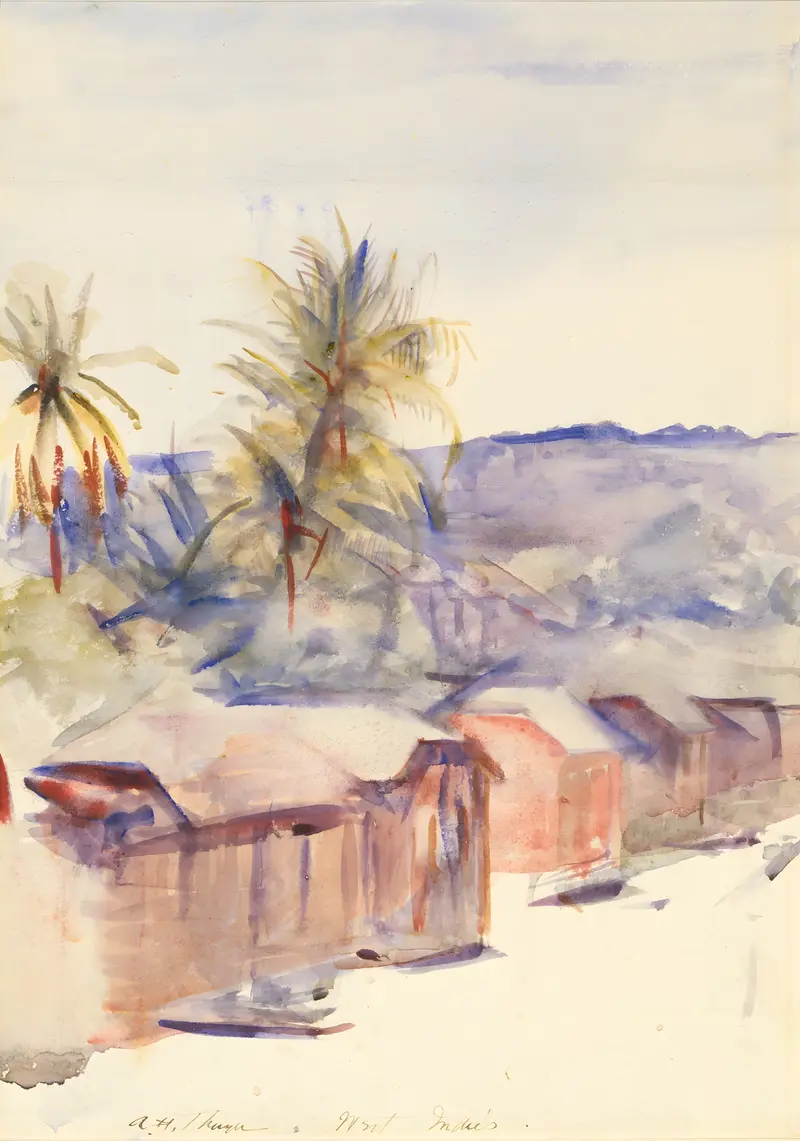
Village Street, Dominica
Abbott Handerson Thayer





