
Portrait of Rembrandt — History & Facts
In 1640, at the height of his early fame in Amsterdam, Rembrandt van Rijn painted himself in a way that sparked immediate comparison with the great Italian and Flemish masters. This Portrait of Rembrandt was not just a likeness, but a public statement: the artist, then only 34, deliberately echoed the pose and costume of Titian’s Portrait of a Man and Raphael’s Baldassare Castiglione, both then celebrated in the Dutch Republic. By referencing these icons, Rembrandt placed himself in the lineage of Europe’s most admired painters, signaling his ambition and self-confidence to collectors and rivals alike.
The painting quickly became a talking point among Amsterdam’s elite, who recognized the visual quotation and its boldness. The scene is not one of action, but of assertion: Rembrandt meets the viewer’s gaze directly, his left arm resting on a ledge, his right hand tucked into his sash. The elaborate black costume, trimmed with white lace, and the soft, fur-lined beret recall the dignified attire of Renaissance humanists. Light falls across his face and hands, picking out the textures of flesh, fabric, and gold chain—a mark of artistic distinction.
Unlike the introspective or playful self-portraits of his earlier years, here Rembrandt presents himself as a man of learning and status, a painter who belongs among the intellectual elite. Compared to Albrecht Dürer’s self-portraits, which also assert the artist’s status, Rembrandt’s version is warmer and more accessible, inviting the viewer into a private moment of self-recognition. The journey of Portrait of Rembrandt as an object is less dramatic than some of his later works, but it has long been prized by collectors and museums. While its original patron is not documented, the painting remained in private Dutch collections for centuries before entering a major public collection in the nineteenth century.
Scholars have debated the exact medium—whether oil on canvas or panel—but agree on its place as a pivotal work in Rembrandt’s career, marking his transition from brash youth to established master. Today, the painting is a highlight of any gallery in which it hangs, admired for both its technical finesse and its bold assertion of the artist’s identity. Its enduring appeal lies in the way it captures not just a face, but an ambition, at a turning point in Rembrandt’s life.
More Artworks by Rembrandt van Rijn

The Return of the Prodigal Son
Rembrandt van Rijn

The Crucifixion
Rembrandt van Rijn

Rembrandt and Saskia in the Scene of the Prodigal Son
Rembrandt van Rijn

Self-Portrait in a heavy Fur Cap: Bust
Rembrandt van Rijn

Portrait of a Seated Old Woman with Clasped Hands
Rembrandt van Rijn

Portrait of a Young Woman
Rembrandt van Rijn

Portrait of Hendrickje Stoffels
Rembrandt van Rijn

Portrait of the Artist
Rembrandt van Rijn

Portraits of Jean Pellicorne and his Son Casper
Rembrandt van Rijn
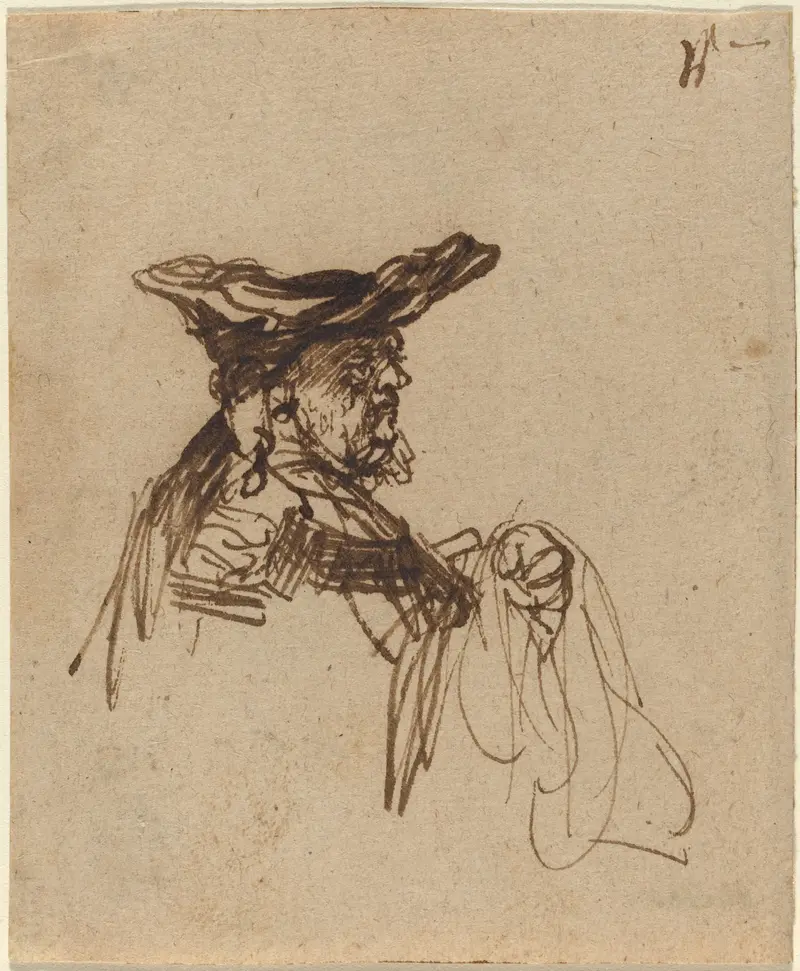
Bust of an Elderly Man in a Flat Cap
Rembrandt van Rijn





