
Portrait of the Artist — History & Facts
No other artist left as many self-portraits as Rembrandt van Rijn, and Portrait of the Artist from 1660 stands among the most searching of them all. Painted when Rembrandt was facing bankruptcy and personal hardship, this image has become a touchstone for understanding the artist’s resilience and self-scrutiny. The work is often discussed for its raw honesty—Rembrandt does not flatter himself, but instead records the marks of age, care, and experience.
Unlike the grand self-portraits of his earlier years, here he presents himself unadorned, confronting his own reflection with a gaze that is both weary and unyielding. The painting captures Rembrandt at a moment of introspection: he sits before us, hands folded, his eyes meeting the viewer’s with a directness that borders on confrontation. The light falls across his face, accentuating the furrows of his brow and the sag of his cheeks, while the background remains shadowy and indistinct. His simple clothing—no gold chains, no painter’s tools—underscores the humility of the image.
The brushwork is loose and textured, especially in the face and hands, as if Rembrandt is sculpting himself out of paint. Compared to Albrecht Dürer’s famously composed and idealized self-portraits, Rembrandt’s approach is intimate and unsparing, inviting us to see both the artist and the man. The precise early history of Portrait of the Artist is not fully documented, and the painting’s medium is still a subject of scholarly debate, though it is generally thought to be oil on canvas. Like many of Rembrandt’s late works, it was likely painted for his own satisfaction rather than on commission, reflecting a period when his fortunes had declined but his creative powers remained undiminished.
Over the centuries, the painting has passed through various hands, surviving periods of neglect and rediscovery, and today it is recognized as a key work in Rembrandt’s late career. Its frankness and humanity have made it an enduring icon of self-portraiture, studied and admired by artists and historians alike.
More Artworks by Rembrandt van Rijn

The Return of the Prodigal Son
Rembrandt van Rijn

The Crucifixion
Rembrandt van Rijn

Rembrandt and Saskia in the Scene of the Prodigal Son
Rembrandt van Rijn

Self-Portrait in a heavy Fur Cap: Bust
Rembrandt van Rijn

Portrait of a Seated Old Woman with Clasped Hands
Rembrandt van Rijn

Portrait of a Young Woman
Rembrandt van Rijn

Portrait of Hendrickje Stoffels
Rembrandt van Rijn

Portrait of Rembrandt
Rembrandt van Rijn

Portraits of Jean Pellicorne and his Son Casper
Rembrandt van Rijn
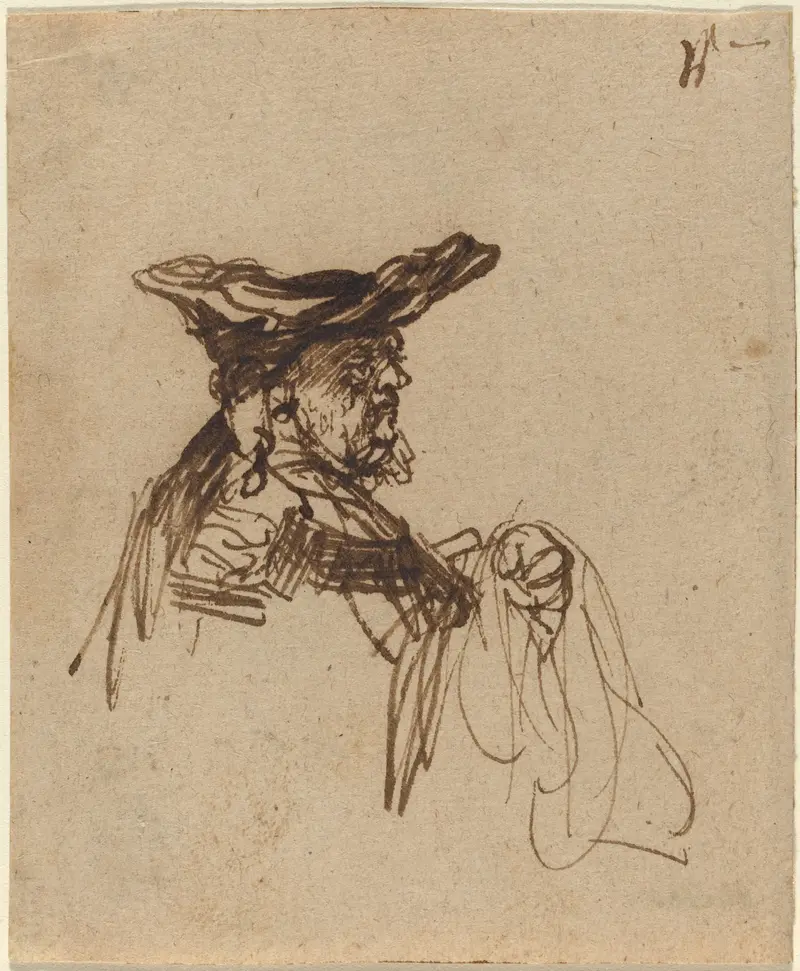
Bust of an Elderly Man in a Flat Cap
Rembrandt van Rijn





