
Portret van Charles Gauzargues — History & Facts
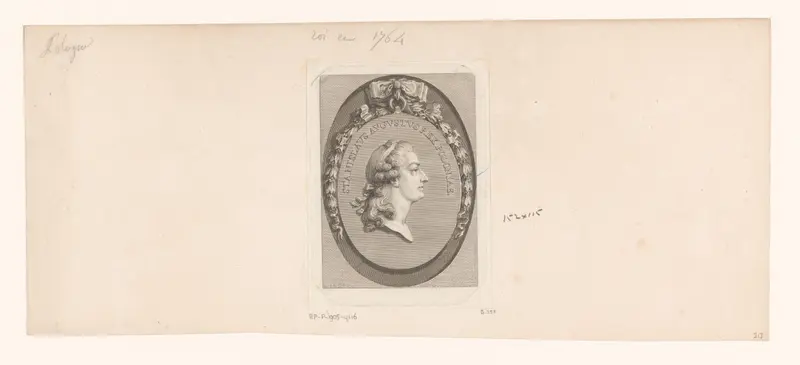
What first draws the eye in Portret van Charles Gauzargues by Augustin de Saint-Aubin is the precision with which the sitter’s profile is rendered, enclosed within a classical medallion that seems to elevate him to the status of antiquity’s worthies. The crispness of the line, the careful modulation of shadow across the brow and cheek, and the dignified tilt of the head all speak to a man of standing and intellect. The oval frame, crowned with a ribbon, is not merely decorative—it signals honor, suggesting that this is a portrait meant for public admiration rather than private memory.
Below, the inscription grounds the image in the world of official titles and ecclesiastical offices, inviting the viewer to read the sitter’s story as much as to study his features. This print belongs to the world of 18th-century France, where engraved portraits served as both commemoration and advertisement for the achievements of notable men. Such works were often commissioned by families, institutions, or the sitters themselves, eager to secure a place in the visual record of their age. Augustin de Saint-Aubin was a prolific engraver in this period, known for his ability to capture both likeness and character with a few deft strokes.
While history has kept few traces of Charles Gauzargues beyond what is inscribed here, the print’s careful formality and clarity of line speak volumes about the values of its time—order, reason, and the enduring power of reputation. Look again at the sitter’s composed expression and the laurel-crowned medallion: here, the Enlightenment’s faith in merit and memory is etched in copper and ink.
More Artworks by Augustin de Saint-Aubin

Parade
Augustin de Saint-Aubin

Profielportret van een oudere man met pruik
Augustin de Saint-Aubin

Vertumnus en Pomona in een parklandschap
Augustin de Saint-Aubin

Portret van Jacques Roëttiers III
Augustin de Saint-Aubin

Portret van Jean-Baptiste Lully
Augustin de Saint-Aubin

Portret van Jean Baptiste Marie Pierre
Augustin de Saint-Aubin

Portret van Jean-Joseph Cassanéa de Mondonville
Augustin de Saint-Aubin

Portret van Joseph Charles Roëttiers
Augustin de Saint-Aubin

Portret van Pierre de Jélyotte
Augustin de Saint-Aubin
Portret van Stanislaus II Augustus van Polen
Augustin de Saint-Aubin





