Vertumnus en Pomona in een parklandschap — History & Facts
It is the sly intimacy at the heart of this scene that first catches the eye: an elderly figure, veiled and intent, leans close to a young woman whose bare shoulder and relaxed posture signal both innocence and a certain knowing ease. The old man’s hand gestures toward her, while her gaze drifts away, half-aware, half-enticed. Around them, the forested parkland is alive with detail—lush foliage, a cornucopia of fruit, and a mischievous putto clutching a theatrical mask, all hinting at themes of disguise, seduction, and transformation.
The light falls softly across the figures, drawing the viewer’s attention to the gentle interaction at the center, while the background recedes into a dreamy, classical landscape. This print by Augustin de Saint-Aubin, dated 1765, belongs to a world where mythological tales were recast as playful, elegant dramas for the drawing rooms of Enlightenment Europe. The subject, Vertumnus and Pomona, is drawn from Ovid’s Metamorphoses: Vertumnus, god of seasons and change, woos the orchard nymph Pomona by adopting many disguises, here appearing as an old woman to win her trust. Prints like this were prized for their ability to bring the refined pleasures of classical myth to a wider audience, often serving as conversation pieces or models for decorative arts.
Though history has kept few traces of this specific impression’s journey, its delicate lines and theatrical composition invite us to linger on the moment of transformation, and to imagine the stories that might unfold just beyond the frame.
More Artworks by Augustin de Saint-Aubin

Parade
Augustin de Saint-Aubin

Profielportret van een oudere man met pruik
Augustin de Saint-Aubin

Portret van Charles Gauzargues
Augustin de Saint-Aubin

Portret van Jacques Roëttiers III
Augustin de Saint-Aubin

Portret van Jean-Baptiste Lully
Augustin de Saint-Aubin

Portret van Jean Baptiste Marie Pierre
Augustin de Saint-Aubin

Portret van Jean-Joseph Cassanéa de Mondonville
Augustin de Saint-Aubin

Portret van Joseph Charles Roëttiers
Augustin de Saint-Aubin

Portret van Pierre de Jélyotte
Augustin de Saint-Aubin
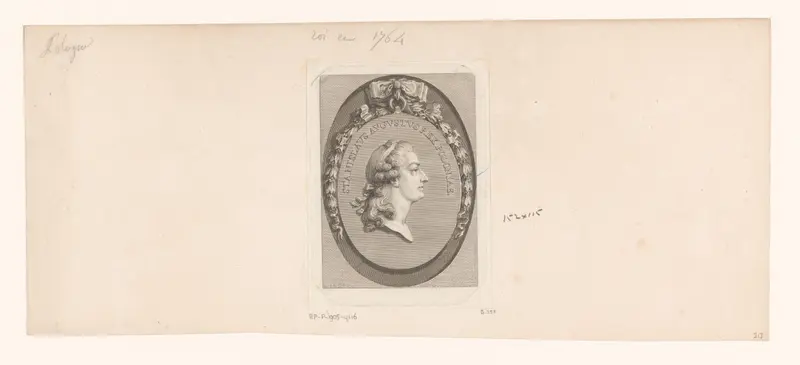
Portret van Stanislaus II Augustus van Polen
Augustin de Saint-Aubin