
Portret van Jean-Baptiste Lully — History & Facts
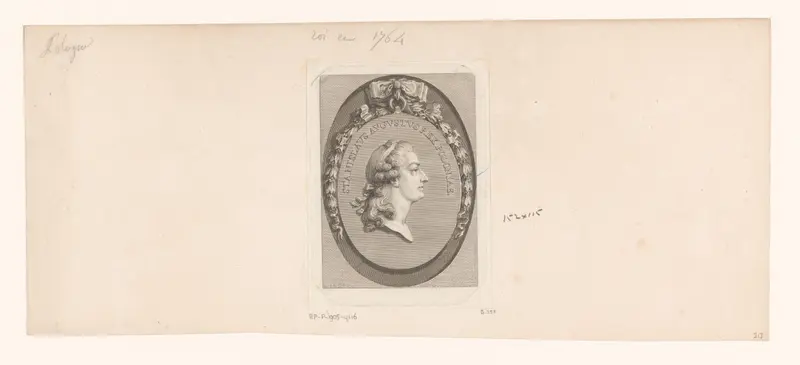
What first seizes the viewer in Portret van Jean-Baptiste Lully by Augustin de Saint-Aubin is the sense of monumentality compressed into a modest print. The composer’s profile, rendered with crisp precision, is framed by a heavy laurel wreath and a medallion, as if he were a Roman emperor rather than a court musician. The laurel, a classical symbol of victory and honor, signals Lully’s triumph in the world of music, while the clean, architectural lines of the frame lend the portrait a gravitas befitting his legacy.
Every curl in his elaborate wig and every line etched into his face seems to declare: here is a man who shaped the sound of a nation. Works like this were not mere likenesses but public statements, especially in the late eighteenth century when prints circulated as tokens of fame and memory. Portrait engravings of celebrated figures—composers, writers, statesmen—were commissioned by admirers, publishers, or institutions eager to align themselves with genius. Augustin de Saint-Aubin, active in Paris at a time when the print was both art and currency, specialized in such commemorations.
Little is recorded about the specific journey of this sheet, but its presence in the Rijksmuseum today is a testament to the enduring power of images to confer immortality. Look again at the proud tilt of Lully’s head: it is the posture of someone who knows his music will outlast the paper itself.
More Artworks by Augustin de Saint-Aubin

Parade
Augustin de Saint-Aubin

Profielportret van een oudere man met pruik
Augustin de Saint-Aubin

Vertumnus en Pomona in een parklandschap
Augustin de Saint-Aubin

Portret van Charles Gauzargues
Augustin de Saint-Aubin

Portret van Jacques Roëttiers III
Augustin de Saint-Aubin

Portret van Jean Baptiste Marie Pierre
Augustin de Saint-Aubin

Portret van Jean-Joseph Cassanéa de Mondonville
Augustin de Saint-Aubin

Portret van Joseph Charles Roëttiers
Augustin de Saint-Aubin

Portret van Pierre de Jélyotte
Augustin de Saint-Aubin
Portret van Stanislaus II Augustus van Polen
Augustin de Saint-Aubin





