Seascape with Ruins on a Cliff — History & Facts
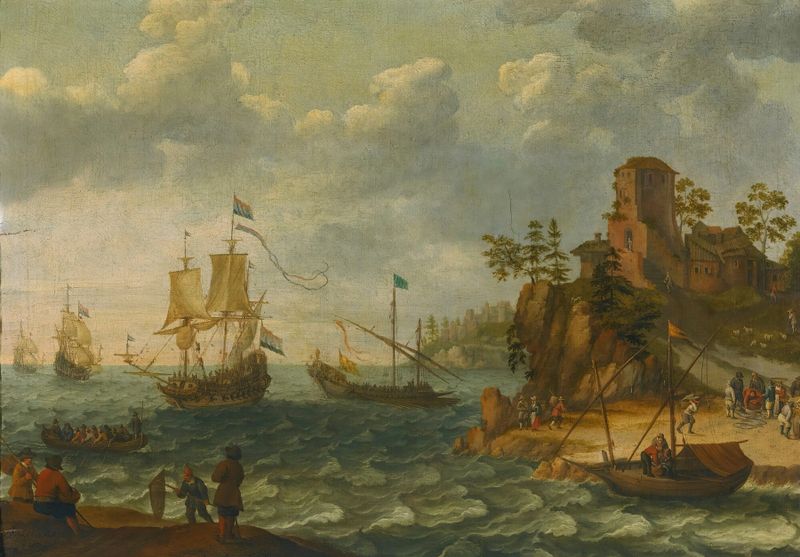
In an era poised on the cusp of revolution, art became both a refuge and a battleground for ideas. This seascape, with its sublime blend of nature and decay, invites contemplation on the transient beauty of civilization. Look to the left at the jagged cliffs; they stand resolute against the crashing waves below. The artist employs a muted palette of blues and grays that dance with light, reflecting the tumult of both sea and sky.
Notice how the remnants of architecture cling precariously to the edge, their weathered surfaces illuminated by a soft, golden light—a stark contrast to the chaos of the ocean. Each element is intricately detailed, guiding the viewer’s gaze from the ruins to the horizon, where the vastness of water hints at untold stories just out of reach. The juxtaposition of the sturdy cliffs and the eroding ruins speaks to the fragility of human endeavors amid the relentless forces of nature. Here, the artist captures an emotional tension—between permanence and impermanence, despair and hope.
The soft, swirling clouds above evoke both a calm and a storm, reflecting the duality of existence, while the light filtering through suggests a glimmer of potential beyond destruction. In 1641, during the height of the Dutch Golden Age, Willaerts painted this piece in the Netherlands, where maritime trade thrived, and new ideas around art and society were beginning to circulate. His work reflects both the natural beauty of his homeland and the looming uncertainties of change in a world shifting towards modernity. It encapsulates a moment where artistry mirrored the complexities of life itself, poised between stability and upheaval.