SS Copenhagen — History & Facts
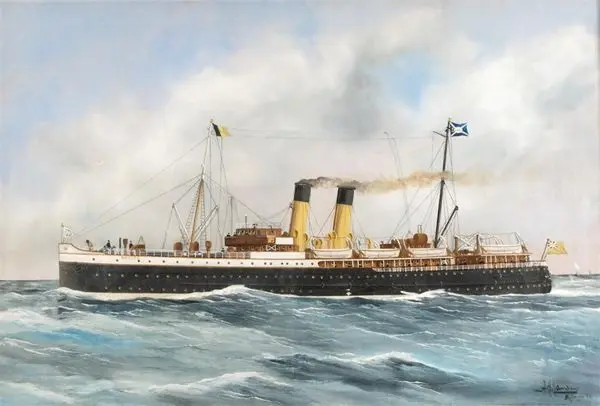
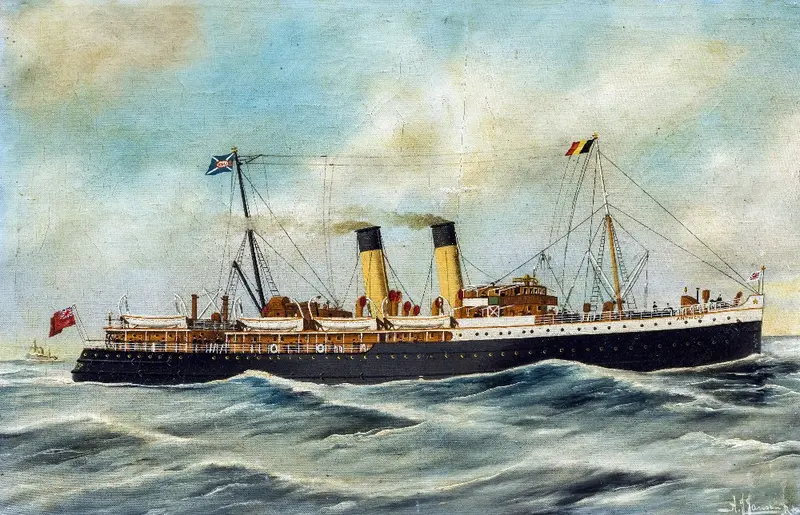
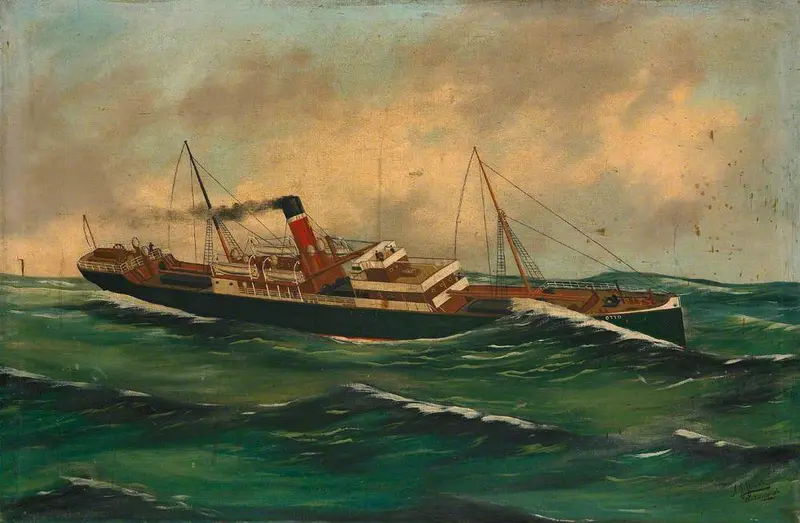
The eye is drawn first to the proud silhouette of the SS Copenhagen, her twin funnels pouring a steady ribbon of smoke into a sky brushed with soft, shifting clouds. The ship’s hull cuts sharply through the blue-green water, every line crisp and purposeful, while flags flutter at mast and stern—signals of identity and allegiance that would have been instantly legible to any mariner of the early twentieth century. The artist, A.
J. Jansen, anchors the vessel in a moment of dignified progress, the low horizon granting the steamer a sense of scale and importance. The careful rendering of rigging and deck detail invites the viewer to linger, decoding the language of steamship travel at the height of its era.
Even the play of light on the water seems to urge the ship forward, promising journeys yet to come. Painted in 1915, this work stands at the crossroads of tradition and transformation in maritime art. Ship portraits like this were often commissioned by shipping lines or captains, serving as both record and celebration of technological achievement. The early twentieth century was an age when steamships symbolized modernity and global connection, and artists such as Jansen responded with works that balanced accuracy with a quiet sense of pride.
History has kept few traces of Jansen’s individual commissions, but the presence of SS Copenhagen in a public collection today lets us glimpse a world where the sea was a highway of ambition and the ship itself a floating emblem of its time. Let your gaze return to the painting and imagine the stories carried across those painted waves.