Study of a Woman — History & Facts
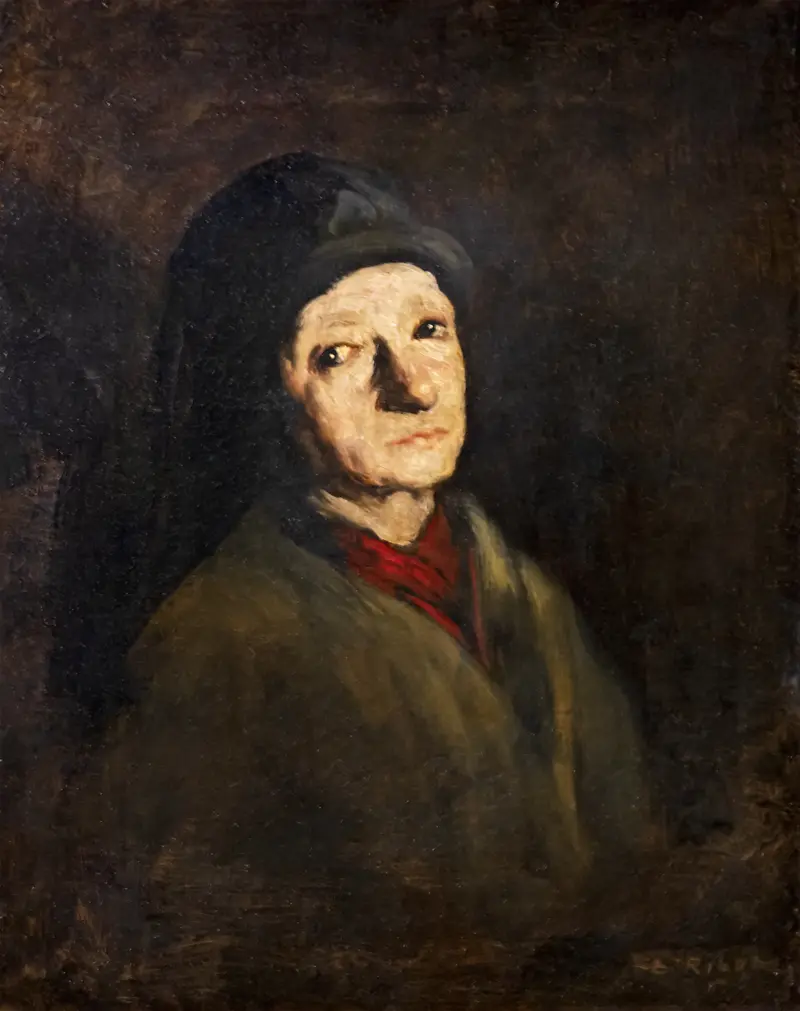
A single shaft of light falls across the woman’s bowed head, catching the rough weave of her apron and the curve of her cheek. The paint itself seems almost sculpted, thick and tactile, as if Augustin Théodule Ribot wanted the viewer to feel the very weight of the fabric and the gravity of her quiet moment. Her hands, clasped around a small object, are rendered with a tenderness that draws the eye, suggesting both humility and a private strength.
The background recedes into darkness, focusing all attention on her inward gaze and the silent story unfolding in the space between her hands and her heart. Works like Study of a Woman belong to a moment in the nineteenth century when artists turned their attention to the lives of ordinary people, often capturing moments of introspection or labor. Ribot, known for his affinity with the realism of earlier Dutch masters, painted with an honesty that set him apart from the polished academic style of his day. This study, with its earth-toned palette and unvarnished humanity, would have resonated with viewers seeking authenticity in an era of rapid change.
Little is recorded about this specific painting beyond its recent documentation in a private collection on 11 November 2021, but its quiet dignity invites us to linger, searching the shadows for the life behind the pose.
More Artworks by Augustin Théodule Ribot

The Scullion
Augustin Théodule Ribot

The Artist's Daughter
Augustin Théodule Ribot

The oyster and the Litigant's
Augustin Théodule Ribot

The philosophers
Augustin Théodule Ribot

Singers
Augustin Théodule Ribot

Oyster and timbale
Augustin Théodule Ribot
Portrait of the artist's mother
Augustin Théodule Ribot

Three old jews
Augustin Théodule Ribot

' Landscape ', known as ' La Maison de Corot in Ville-d'Avray '
Augustin Théodule Ribot
La recette du cuisinier
Augustin Théodule Ribot