
Temptation — History & Facts
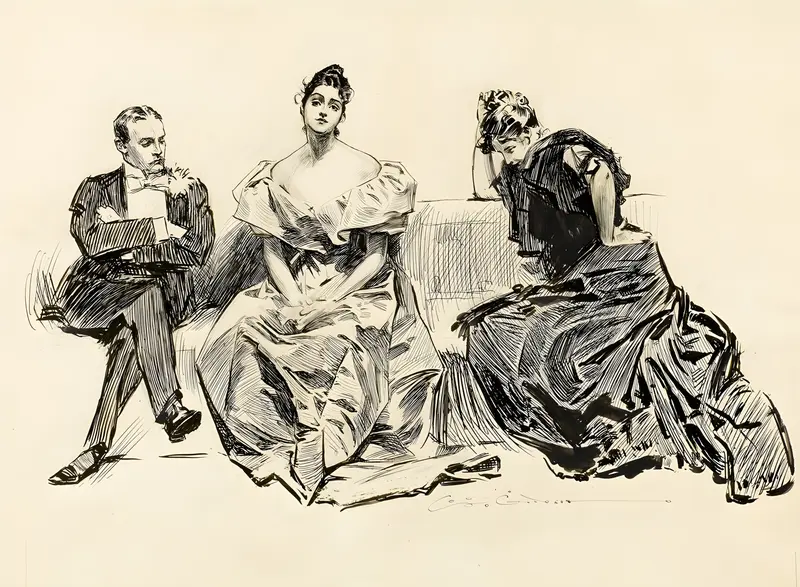
Few images so perfectly capture the spirit of an era as Temptation by Charles Dana Gibson, whose iconic “Gibson Girl” illustrations defined American ideals of beauty and wit at the turn of the twentieth century. When Gibson published his drawings in magazines like Life and Harper’s Weekly, they quickly became a social phenomenon, sparking debates about gender roles and modern womanhood. The precise date and medium of Temptation remain uncertain, but its subject and style unmistakably belong to the golden age of American illustration, when Gibson’s pen shaped the image of the “New Woman” for a generation. In Temptation, a poised young woman sits at the center, her profile illuminated as she contemplates a single rose offered by a dapper suitor.
The moment is one of decision: her gloved hand hovers, not yet accepting the flower, while her gaze betrays both curiosity and restraint. The crisp lines and restrained palette focus attention on her expression and the symbolic rose, a classic emblem of romance and risk. Unlike the overt drama of John Everett Millais’s Ophelia, Gibson’s scene is subtle, relying on gesture and social cues to convey the tension between propriety and desire.
The woman’s upright posture, fashionable dress, and composed demeanor all signal the expectations placed upon her, even as the rose tempts her to break them. As with many of Gibson’s works, the original drawing for Temptation likely circulated widely in print, rather than hanging in a single gallery or private collection. The lack of a known date or medium reflects the ephemeral nature of magazine illustration in the late nineteenth and early twentieth centuries, when such images were meant to be seen, discussed, and quickly replaced by the next sensation. Today, Temptation survives in digital archives and anthologies of Gibson’s art, a testament to the enduring fascination with his vision of American society.
For Gibson, works like this were not just pictures, but cultural touchstones, shaping and reflecting the aspirations and anxieties of his age.
More Artworks by Charles Dana Gibson

To see the art editor
Charles Dana Gibson

In the Lord Chief Justice’s Court
Charles Dana Gibson

A Sidewalk Artist
Charles Dana Gibson

A special exhibit
Charles Dana Gibson

At Dinner
Charles Dana Gibson

At the royal academy
Charles Dana Gibson

At the Savoy
Charles Dana Gibson

Some of the caretaker’s relations
Charles Dana Gibson

Theodore Roosevelt
Charles Dana Gibson
Determined Woman
Charles Dana Gibson





