
At the royal academy — History & Facts
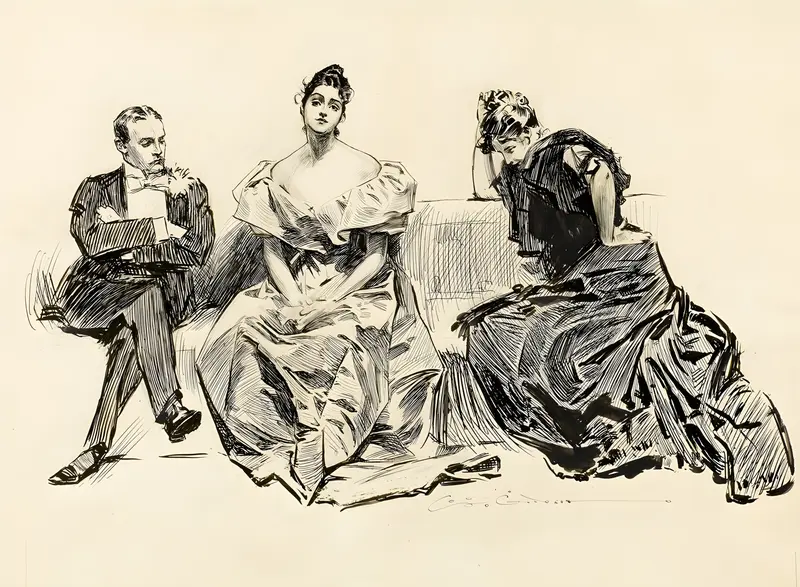
Few images have so sharply captured the shifting social roles of women at the turn of the twentieth century as At the royal academy by Charles Dana Gibson. The work is one of the most recognizable examples of the "Gibson Girl" phenomenon, a cultural icon that shaped ideals of beauty and independence in America and abroad. When first published in a popular magazine, the drawing sparked lively debate about the presence of women in academic and artistic institutions, a topic that was making headlines as women fought for greater access and recognition. In At the royal academy, Gibson freezes a moment of mingled admiration and scrutiny: a group of elegantly dressed women, their posture confident and gaze direct, stand before a row of male artists or critics.
The men, some peering over spectacles, others whispering among themselves, seem both captivated and unsettled by the women's presence. The women's elaborate hats and tailored dresses signal their social standing, while their self-assured demeanor hints at new possibilities for female agency. The composition's gentle satire recalls similar scenes by William Powell Frith or James Tissot, but Gibson's line is sharper, his focus squarely on the shifting balance of power. The exact date and medium of At the royal academy remain uncertain, as is often the case with Gibson's prolific output for periodicals and books.
Originally created as an illustration—most likely in pen and ink—for a magazine such as Life or Harper's Weekly, the work was widely reproduced and helped cement Gibson's reputation as the chronicler of his era's social currents. Today, the original drawing's whereabouts are unclear; it survives primarily through printed versions in collections and archives. As a testament to Gibson's influence, the image continues to be cited in discussions of gender, art, and the rise of the modern woman.
More Artworks by Charles Dana Gibson

Temptation
Charles Dana Gibson

To see the art editor
Charles Dana Gibson

In the Lord Chief Justice’s Court
Charles Dana Gibson

A Sidewalk Artist
Charles Dana Gibson

A special exhibit
Charles Dana Gibson

At Dinner
Charles Dana Gibson

At the Savoy
Charles Dana Gibson

Some of the caretaker’s relations
Charles Dana Gibson

Theodore Roosevelt
Charles Dana Gibson
Determined Woman
Charles Dana Gibson





