
In the Lord Chief Justice’s Court — History & Facts
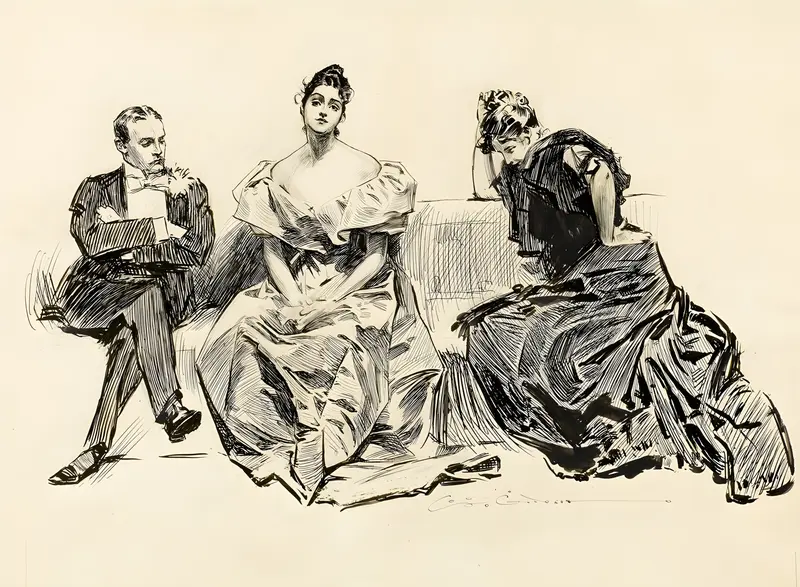
When In the Lord Chief Justice’s Court first appeared in print, it was said to have caused a stir among both the legal profession and the general public, sparking lively debate in letters to the editor about the dignity (or lack thereof) of English justice. The artist, Charles Dana Gibson, was already famous for his satirical illustrations in magazines like Life and Harper’s Weekly, and this particular drawing was widely reprinted, cementing its place in the popular imagination. Its sharp wit and keen observation of social types led some critics to call it "the most talked-about courtroom scene of its day." The work’s notoriety was such that lawyers and judges reportedly clipped and kept copies as mementos—or as warnings. The scene captures a moment of high drama in a Victorian courtroom, with the Lord Chief Justice presiding in full regalia.
Gibson’s pen brings to life the tension and hierarchy of the British legal system: the judge’s stern gaze, the anxious barristers in their powdered wigs, and the gallery packed with curious onlookers. Every gesture is deliberate—the defendant’s clenched hands, the prosecutor’s pointed finger, the subtle exchange of glances among the jury—each detail reinforcing the sense of ritual and scrutiny. The strong contrast of black ink on white paper focuses the eye on the figures’ expressions, much like Honoré Daumier’s satirical courtroom sketches, though Gibson’s style is crisper and more American in its directness.
The composition invites viewers to question the impartiality and spectacle of justice. As with many of Gibson’s works, In the Lord Chief Justice’s Court was originally created for publication rather than exhibition, and its precise date and medium remain uncertain—likely pen and ink on paper, as was his custom. The drawing circulated widely in illustrated magazines and was later reproduced in collections of his work, making it more accessible than most fine art of the era. Today, original impressions can be found in both private collections and public institutions, though few are on permanent display.
This piece marks a high point in Gibson’s career as a social observer, capturing the intersection of law, class, and public performance at the turn of the twentieth century.
More Artworks by Charles Dana Gibson

Temptation
Charles Dana Gibson

To see the art editor
Charles Dana Gibson

A Sidewalk Artist
Charles Dana Gibson

A special exhibit
Charles Dana Gibson

At Dinner
Charles Dana Gibson

At the royal academy
Charles Dana Gibson

At the Savoy
Charles Dana Gibson

Some of the caretaker’s relations
Charles Dana Gibson

Theodore Roosevelt
Charles Dana Gibson
Determined Woman
Charles Dana Gibson
More Genre Scene Art

Banquet of the Officers of the St George Civic Guard
Frans Hals

Rembrandt and Saskia in the Scene of the Prodigal Son
Rembrandt van Rijn

Bal du moulin de la Galette
Pierre-Auguste Renoir

Quadrille at the Moulin Rouge
Henri de Toulouse-Lautrec

A Burial at Ornans
Gustave Courbet

When Will You Marry?
Paul Gauguin