
At Dinner — History & Facts
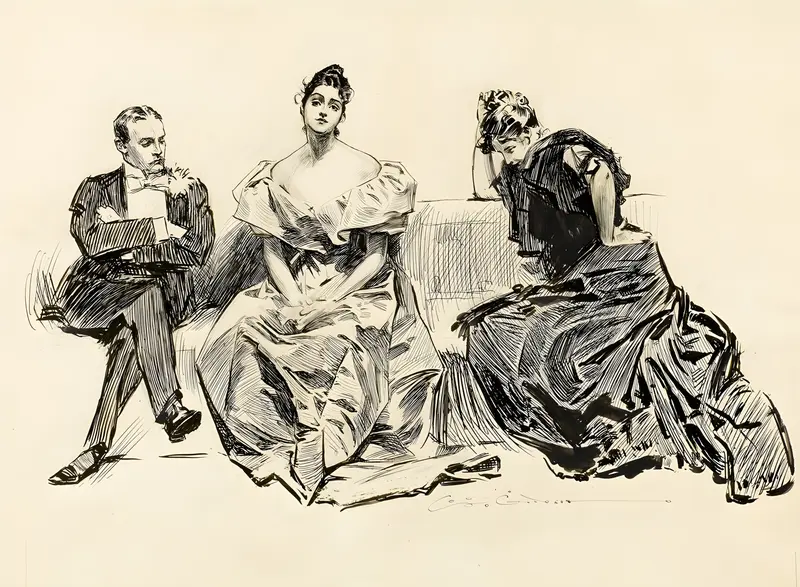
Few images have shaped the American imagination of turn-of-the-century society as lastingly as At Dinner by Charles Dana Gibson. The work immortalizes the so-called “Gibson Girl”—a figure so influential that, by 1901, the New York Times declared, “There is something of the Gibson Girl in every American woman.” Though the exact date and commission of At Dinner remain uncertain, its widespread reproduction in magazines and prints made it instantly recognizable to millions. The drawing’s popularity coincided with the rise of illustrated periodicals, ensuring that Gibson’s vision of modern womanhood reached households across the United States. The scene captures a moment of charged silence: a table of elegantly dressed men and women, their postures rigid, their gazes averted or fixed on unseen thoughts.
The central figure—a poised young woman, chin lifted, eyes half-lidded—commands the viewer’s attention, her confidence contrasting with the tentative gestures of her companions. The crisp white of her gown and the subtle play of light on silver and glass highlight both her social standing and the carefully constructed rituals of upper-class dining. In this tableau, Gibson exposes the unspoken codes and tensions of polite society, much as John Singer Sargent did in his own portraits of the era, though Gibson’s pen is sharper, his satire more biting. As with many works by Charles Dana Gibson, At Dinner was likely first published as an illustration in a popular magazine such as Life or Collier’s Weekly, rather than exhibited in a gallery.
The drawing’s journey has been one of mass reproduction rather than singular display, reflecting the artist’s career-long focus on the power of print media. Today, original Gibson drawings are prized by collectors and appear in both private and public collections, though the precise whereabouts of the original At Dinner are not widely documented. The image remains a touchstone for understanding both the aspirations and the anxieties of the Gilded Age, and a testament to Gibson’s enduring influence on American visual culture.
More Artworks by Charles Dana Gibson

Temptation
Charles Dana Gibson

To see the art editor
Charles Dana Gibson

In the Lord Chief Justice’s Court
Charles Dana Gibson

A Sidewalk Artist
Charles Dana Gibson

A special exhibit
Charles Dana Gibson

At the royal academy
Charles Dana Gibson

At the Savoy
Charles Dana Gibson

Some of the caretaker’s relations
Charles Dana Gibson

Theodore Roosevelt
Charles Dana Gibson
Determined Woman
Charles Dana Gibson
More Genre Scene Art

Banquet of the Officers of the St George Civic Guard
Frans Hals

Rembrandt and Saskia in the Scene of the Prodigal Son
Rembrandt van Rijn

Bal du moulin de la Galette
Pierre-Auguste Renoir

Quadrille at the Moulin Rouge
Henri de Toulouse-Lautrec

A Burial at Ornans
Gustave Courbet

When Will You Marry?
Paul Gauguin