
Tennis Court — History & Facts
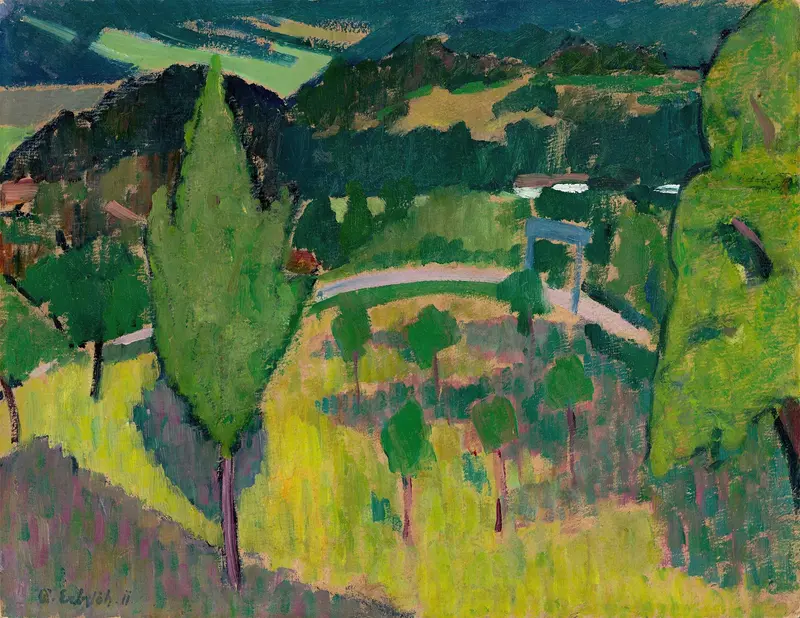
A tennis match unfolds beneath a brooding sky, but it is the electric contrast of lime-yellow courts and shadowed trees that first seizes the eye. The players, rendered in crisp, almost spectral whites, are suspended mid-motion, their rackets raised in silent choreography. A woman in the foreground, shaded by a pink parasol, stands apart—her presence both observer and ornament, a reminder that this is not just a game but a scene of society.
The thick, dark outlines and bold patches of color carve the landscape into distinct zones: the glowing court, the dense, enclosing park, the distant, blocky buildings. Light here is not gentle but insistent, slicing through the gloom and lending the leisure activity an unexpected intensity. Painted in 1911, Tennis Court by Adolf Erbslöh belongs to a world on the cusp of modernity, where sport and social ritual mingled in the new public spaces of the early twentieth century. This was the era when tennis, once a preserve of the elite, was becoming a fashionable pursuit for the growing urban middle class, and artists across Europe were drawn to its rhythms and its symbolism of progress.
Erbslöh, associated with the Expressionist movement, channels the energy of the scene through his vivid palette and simplified forms, echoing the experiments of his contemporaries in Germany and France. History has kept few traces of this particular painting’s journey, save for its preservation in the Erbslöh-Archiv in Wuppertal, but its charged atmosphere invites us to linger, searching for stories in the interplay of color, gesture, and light.
More Artworks by Adolf Erbslöh

More Genre Scene Art

Banquet of the Officers of the St George Civic Guard
Frans Hals

Rembrandt and Saskia in the Scene of the Prodigal Son
Rembrandt van Rijn

Bal du moulin de la Galette
Pierre-Auguste Renoir

Quadrille at the Moulin Rouge
Henri de Toulouse-Lautrec

A Burial at Ornans
Gustave Courbet

When Will You Marry?
Paul Gauguin