
The Annunciation — History & Facts
Gabriel, an angel with white wings and a golden halo, enters from the left beneath a series of high arches, his knees bent and one arm extended in greeting. The angel’s blue robe and pink sleeves billow as if caught in movement, while lines of gold radiate from his mouth toward Mary, marking the path of his message. On the right, Mary stands just inside a shadowed room, her body slightly bent forward and her arms crossed over her chest in a gesture of humility and surprise.
She wears a blue mantle over a red dress, and a thin gold halo encircles her head. A wooden lectern stands beside her, with an open book resting on top, and a small bench supports her left foot. The scene is set within an elaborate architectural space, with arches, columns, and a loggia leading out to a walled garden and distant hills under a pale sky.
Fine brushwork defines the folds of fabric, the feathers of Gabriel’s wings, and the architectural details, while the gold lines and halos catch the light. The composition balances the figures on either side of the central architectural axis, drawing attention to the moment of encounter between Gabriel and Mary. The architectural setting features black and white stonework, with deep shadows cast by the arches and columns onto the red-tiled floor.
The far left and right edges of the painting are bordered by tall, shadowed columns that frame the central scene. The paint is applied smoothly, with fine, dark outlines accentuating the contours of the figures and architectural elements throughout the composition. This composition belongs to the Early Renaissance movement and shares features with another Annunciation painted by Botticelli around the same time, now in New York.
Sources: Wikidata Q1114806 · Wikipedia: Annunciation (Botticelli, Glasgow) · Image source (Wikimedia Commons)
More Artworks by Sandro Botticelli

Virgin and Child
Sandro Botticelli

Madonna and Child and the Young St John the Baptist
Sandro Botticelli

Madonna and Child with six angels and Saint John the Baptist as Child
Sandro Botticelli

Adoration of the Magi
Sandro Botticelli

Virgin and Child with the Young Saint John the Baptist
Sandro Botticelli
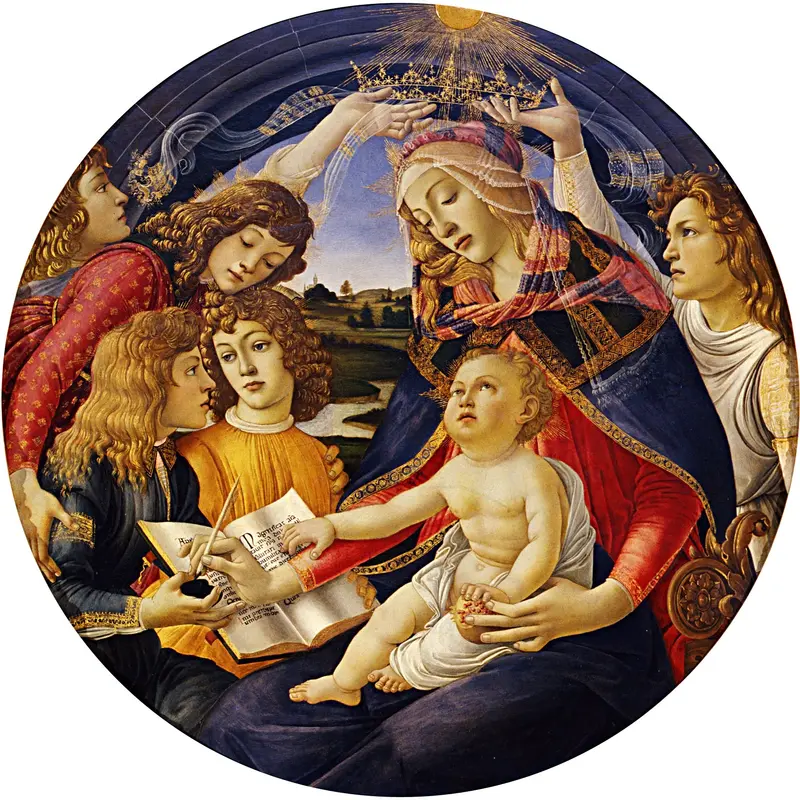
Madonna of the Magnificat
Sandro Botticelli
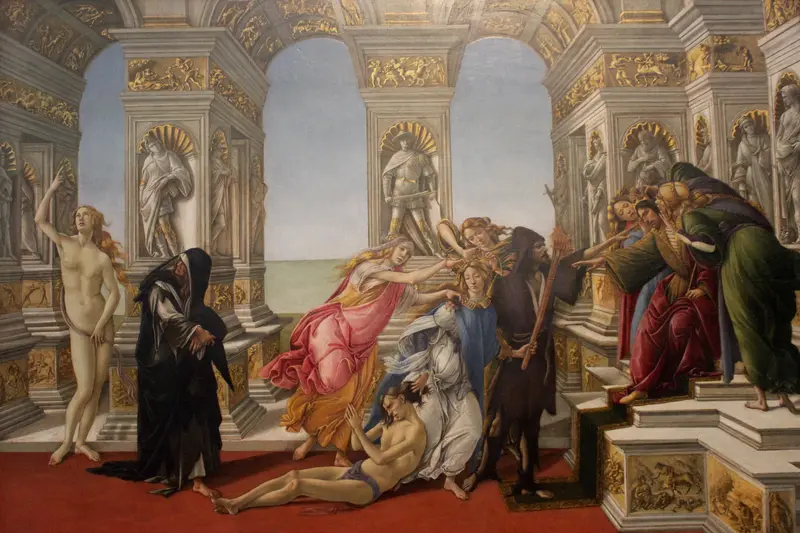
Calumny of Apelles
Sandro Botticelli

Portrait of a young man holding a roundel
Sandro Botticelli

The Trinity with Saint Mary Magdalene and Saint John the Baptist, the Archangel Raphael and Tobias
Sandro Botticelli

Idealized Portrait of a Lady (Portrait of Simonetta Vespucci as Nymph)
Sandro Botticelli





