
The Martyrdom of St. Andrew — History & Facts
The executioners, positioned at the foot of the cross, strain to hoist it upright, their muscular arms and bent postures emphasizing the physical effort of the scene. To the left, a group of figures—women and men—watch the unfolding martyrdom, some turning away or shielding their faces, while others point or gesture in agitation. On the right, a mounted soldier in a plumed combat helmet sits astride a white horse, his back to the viewer, while another soldier stands nearby, holding a spear and accompanied by a white dog.
A red flag rises above the soldiers, its color echoed in the garments of several figures throughout the composition. In the background, classical ruins and distant crowds set the martyrdom in a dramatic, open space, bathed in a turbulent, cloud-filled sky. The light falls most strongly on Saint Andrew’s body, illuminating his pale flesh and drawing attention to his suffering, while the surrounding figures are cast in deeper shadow.
Murillo uses energetic, visible brushstrokes to build up the swirling clouds and the rough textures of the ground and garments, creating a sense of movement and immediacy. The color scheme is dominated by earthy browns, ochres, and muted greens, punctuated by flashes of red and white that guide the viewer’s eye across the canvas. The composition is carefully balanced, with the diagonal of the cross anchoring the scene and the crowd arranged in a sweeping arc around the central figure.
Small details, such as the tools scattered at the base of the cross and the expressive faces of the bystanders, contribute to the narrative intensity of the moment. Objects such as the combat helmet, sword, spear, and axe, visible among the soldiers, reinforce the scene’s atmosphere of violence and authority.
Sources: Museo del Prado, record P000982 · Wikidata Q11681382 · Wikipedia: The Martyrdom of Saint Andrew (Murillo) · Image source (Wikimedia Commons)
More Artworks by Bartolomé Estebán Murillo

Virgin and Child in Glory
Bartolomé Estebán Murillo

Vision of St Antony of Padua
Bartolomé Estebán Murillo

Penitent Magdalene
Bartolomé Estebán Murillo

The Apparition of the Virgin to Saint Bernard
Bartolomé Estebán Murillo

Madonna and Child
Bartolomé Estebán Murillo

The Immaculate Conception
Bartolomé Estebán Murillo

The Virgin, from The Immaculate Conception
Bartolomé Estebán Murillo

The Mystical Marriage of Saint Catherine
Bartolomé Estebán Murillo

Murillo-inmaculada-catedral sevilla
Bartolomé Estebán Murillo
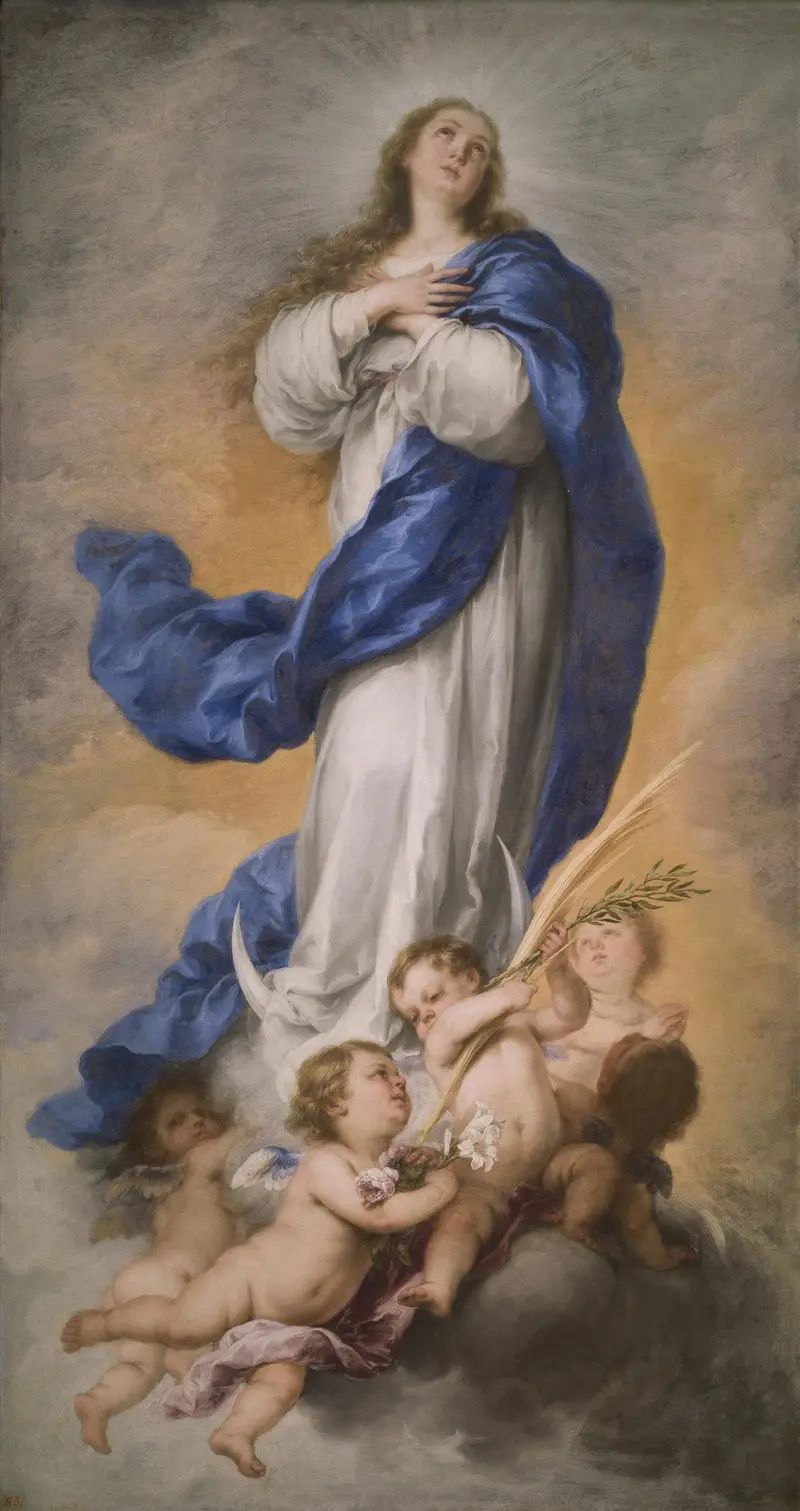
The Aranjuez Immaculate Conception
Bartolomé Estebán Murillo





