
Virgin and Child in Glory — History & Facts
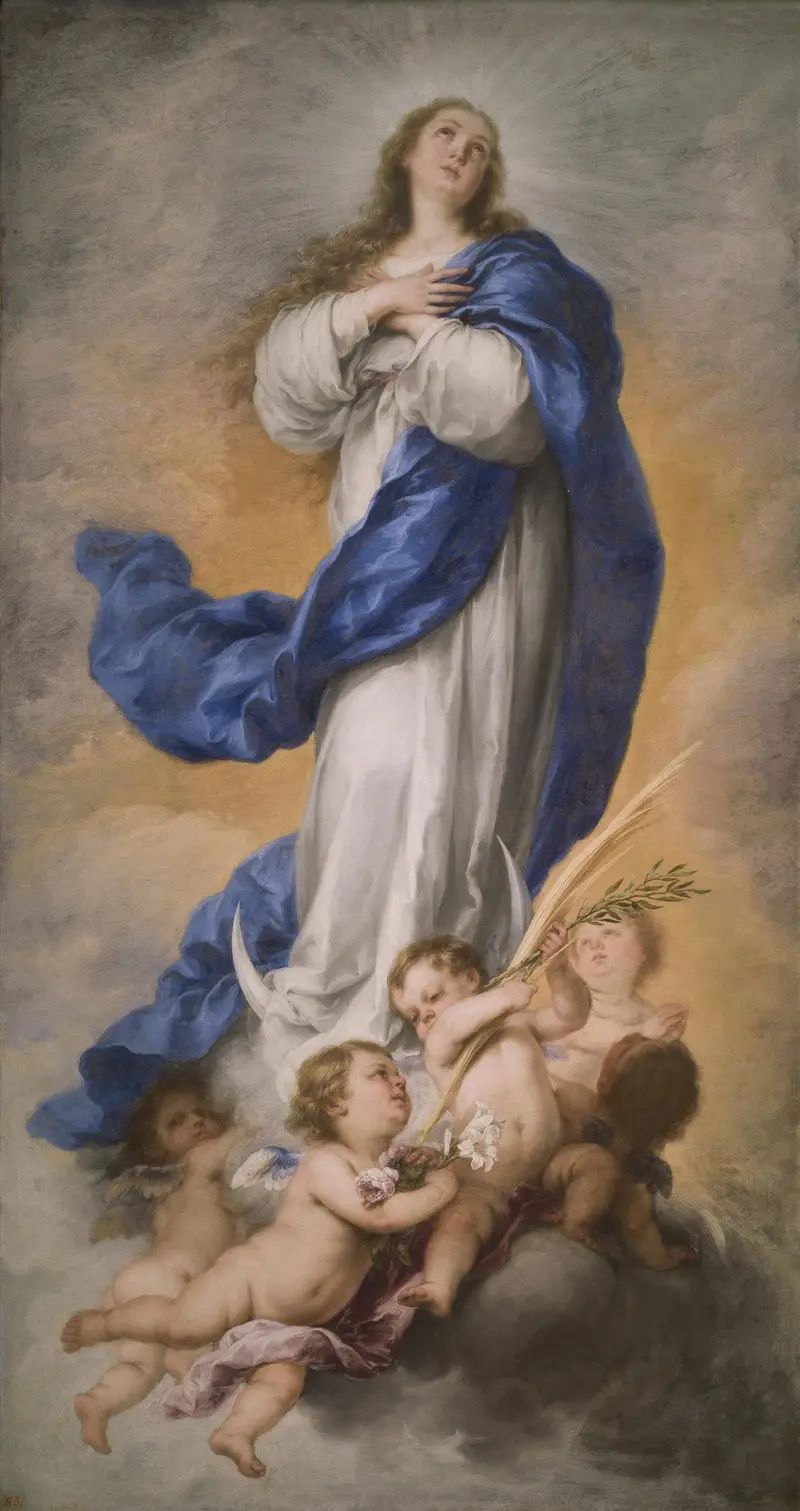
When Virgin and Child in Glory was first unveiled in 1673, it was immediately recognized as a crowning achievement of Bartolomé Estebán Murillo’s late career, painted at the height of his fame in Seville. The work is notable for its remarkable popularity: Murillo returned to this theme numerous times, and his images of the Virgin became so beloved that they shaped the Spanish vision of the Madonna for generations. In the 18th century, Murillo’s Madonnas were so widely copied that even the French critic Jean-Baptiste Lebrun called him "the painter of the Virgin par excellence." This particular composition stands out for its radiant, upward sweep and the tender intimacy between mother and child. Murillo captures the Virgin Mary at the very moment she is borne aloft on clouds, surrounded by a host of cherubs, presenting the Christ Child to the viewer.
The infant Jesus, nestled in her arms, looks out with a gentle gravity, while Mary’s gaze is cast heavenward, her hands delicately supporting her son. The swirling clouds and golden light enveloping the figures suggest divine presence, while the putti below offer roses and lilies—symbols of purity and love. Murillo’s soft brushwork and glowing palette set his vision apart from, for example, the more austere and sculptural Madonnas of Francisco de Zurbarán, emphasizing warmth and human connection over solemnity. The precise early history of Virgin and Child in Glory is not fully documented, but paintings of this type were often commissioned by religious confraternities or wealthy patrons for private devotion in 17th-century Seville.
Murillo’s reputation as the leading painter of the Spanish Baroque ensured that his works were eagerly collected, not only in Spain but across Europe. Over the centuries, many of his Madonnas—including this one—have been dispersed from their original settings, sometimes passing through the hands of collectors or religious orders before entering museum collections. Today, Virgin and Child in Glory is recognized as a quintessential example of Murillo’s devotional art, embodying the gentle piety and luminous color that made him one of the most influential painters of his era.
Sources: Wikidata Q28777907 · Image source (Wikimedia Commons)
More Artworks by Bartolomé Estebán Murillo

Vision of St Antony of Padua
Bartolomé Estebán Murillo

Penitent Magdalene
Bartolomé Estebán Murillo

The Apparition of the Virgin to Saint Bernard
Bartolomé Estebán Murillo

The Martyrdom of St. Andrew
Bartolomé Estebán Murillo

Madonna and Child
Bartolomé Estebán Murillo

The Immaculate Conception
Bartolomé Estebán Murillo

The Virgin, from The Immaculate Conception
Bartolomé Estebán Murillo

The Mystical Marriage of Saint Catherine
Bartolomé Estebán Murillo

Murillo-inmaculada-catedral sevilla
Bartolomé Estebán Murillo
The Aranjuez Immaculate Conception
Bartolomé Estebán Murillo





