
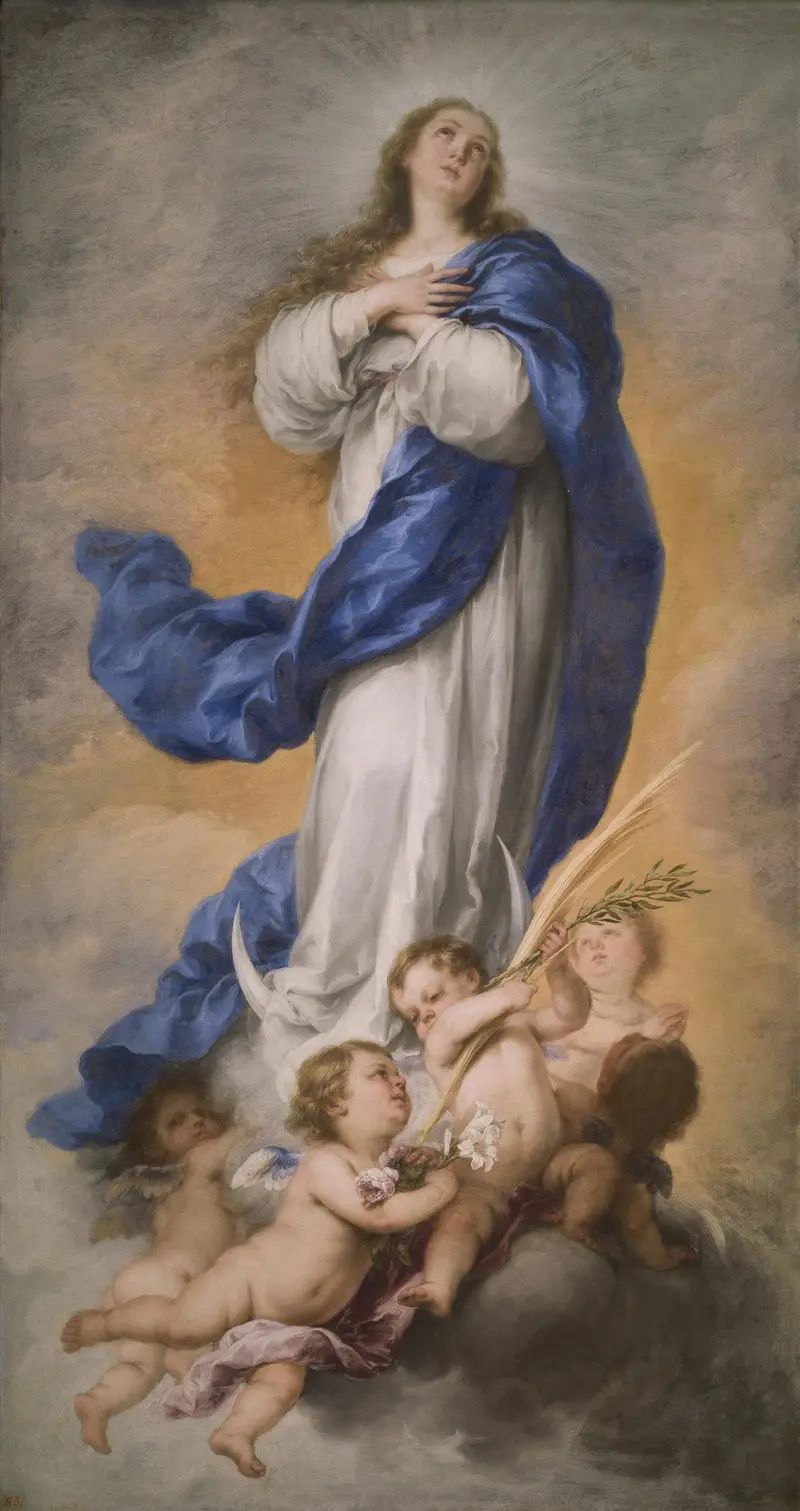
The Virgin, from The Immaculate Conception — History & Facts
When Bartolomé Estebán Murillo painted The Virgin, from The Immaculate Conception in 1683, he was at the height of his fame, and the doctrine it celebrates was fiercely debated in Spain and Rome alike. The Immaculate Conception—the belief that Mary was conceived without original sin—had become a rallying point for Spanish Catholic identity in the 17th century, inspiring not only theologians but also artists and patrons to champion its cause. Murillo painted more than two dozen versions of the Immaculate Conception, each time refining his vision, and his images became so influential that they helped fix the iconography for generations. In this particular work, Murillo captures the Virgin at the moment of her miraculous purity, suspended above a crescent moon, her hands folded in humility, eyes lifted heavenward.
She is surrounded by a swirl of cherubs and clouds, their rosy faces and fluttering drapery emphasizing her otherworldly grace. The white and blue of her garments symbolize innocence and heavenly favor, while the crescent moon beneath her feet refers to the Woman of the Apocalypse from the Book of Revelation. Unlike the more austere interpretations by earlier artists such as Francisco Pacheco, Murillo’s Virgin radiates warmth and humanity, inviting the viewer into a personal, almost intimate, encounter. The exact commission for this version is not fully documented, but it was likely created for a church or private devotion in Seville, where Murillo spent most of his career.
Over the centuries, many of Murillo’s Immaculate Conceptions were dispersed through sales, war, and changing tastes, with some ending up in major European collections. Today, this painting stands as a testament to the artist’s enduring influence on Marian iconography and the Baroque movement in Spain. While the medium is not specified, Murillo was renowned for his luminous oil technique, which gave his figures their signature softness.
The work remains a highlight of any collection, embodying both the spiritual fervor and artistic innovation of late 17th-century Seville.
Sources: Wikidata Q131542222 · Image source (Wikimedia Commons)
More Artworks by Bartolomé Estebán Murillo

Virgin and Child in Glory
Bartolomé Estebán Murillo

Vision of St Antony of Padua
Bartolomé Estebán Murillo

Penitent Magdalene
Bartolomé Estebán Murillo

The Apparition of the Virgin to Saint Bernard
Bartolomé Estebán Murillo

The Martyrdom of St. Andrew
Bartolomé Estebán Murillo

Madonna and Child
Bartolomé Estebán Murillo

The Immaculate Conception
Bartolomé Estebán Murillo

The Mystical Marriage of Saint Catherine
Bartolomé Estebán Murillo

Murillo-inmaculada-catedral sevilla
Bartolomé Estebán Murillo
The Aranjuez Immaculate Conception
Bartolomé Estebán Murillo





