
The Piazza San Marco — History & Facts
Can paint confess what words never could? In The Piazza San Marco, the artist captures a moment steeped in melancholy, where architectural grandeur meets the transience of human experience. Look to the left at the intricate details of the Basilica di San Marco, its ornate domes gleaming under a soft, diffused light. Notice how the artist employs a palette of muted earth tones, contrasting sharply with the vibrant skies that loom overhead. The delicate brushwork invites the eye to wander through the bustling square, detailing figures absorbed in their own worlds—some lost in conversation, others merely passing by, as shadows dance across the cobblestones. Yet, beneath this lively scene lies an undertow of solitude.
The vastness of the piazza contrasts with the intimate moments shared by its visitors, evoking a sense of isolation amidst the crowd. The absence of any direct gaze between the figures suggests a poignant disconnection, reflecting the bittersweet nature of life in such a crowded space. As viewers, we are brought face-to-face with our collective existence, where joy and sorrow coexist in an endless loop. In 1874, Rudolf von Alt was in Vienna, a time when the art world was shifting towards realism and impressionism.
His portrayal of Venice reveals both an admiration for its historic splendor and a contemplation on the passage of time. This work, created during a period of artistic exploration, captures the essence of a city that has long been a muse, offering layers of meaning both seen and felt.
More Artworks by Rudolf von Alt
Browse all →
Freyung mit Austriabrunnen
Rudolf von Alt

The Interior of the Cathedral of Saint Stephen at Vienna
Rudolf von Alt
The Arch Of Constantine And The Colosseum, Rome
Rudolf von Alt

The Fleischmarkt in Vienna with the Greek-Orthodox Church of the Holy Trinity
Rudolf von Alt

Der Stephansdom in Wien
Rudolf von Alt
Stephansplatz
Rudolf von Alt
The Town Hall in Gmunden
Rudolf von Alt

View from Sant’Onofrio on Rome
Rudolf von Alt
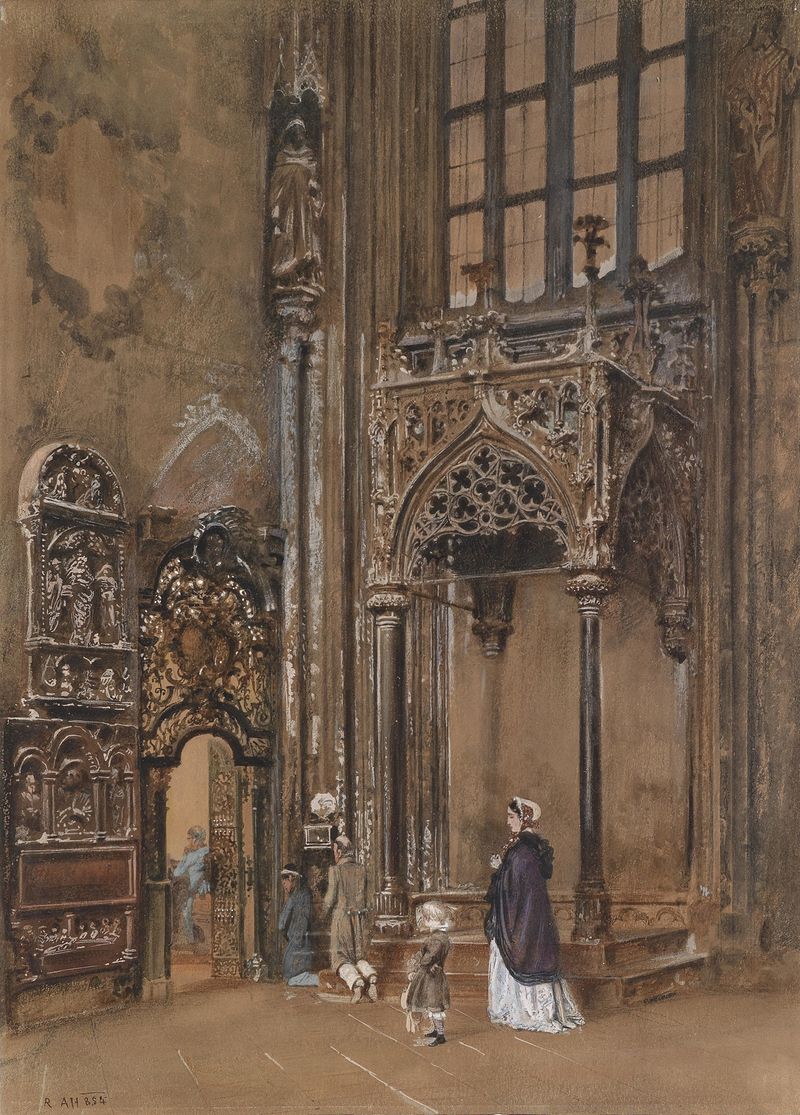
Kircheninneres
Rudolf von Alt
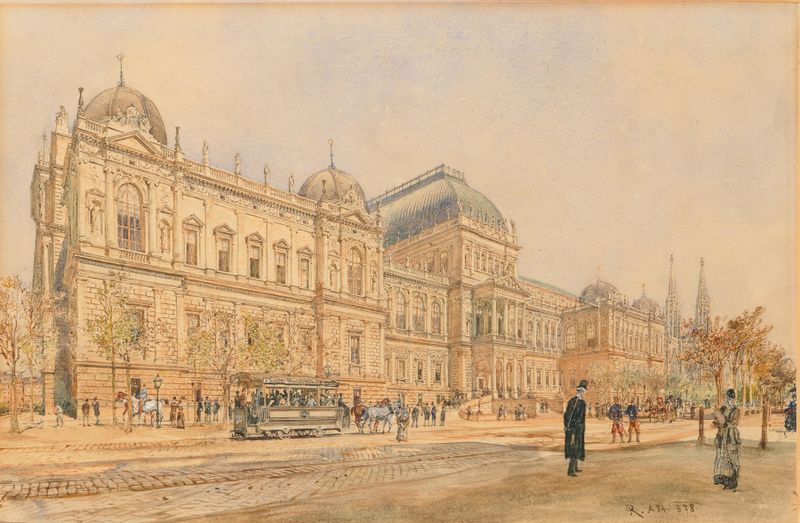
The University of Vienna on the Ringstrasse, with Horse-Drawn Tram and Figures, a view of the building still under construction in 1878 (erected by Heinrich von Ferstel 1873-1884)
Rudolf von Alt
More Architecture Art
Browse all →
The statue of Liberty
Frédéric Auguste Bartholdi

View of Houses in Delft, Known as ‘The Little Street’
Johannes Vermeer

View of Houses in Delft, Known as ‘The Little Street’
Johannes Vermeer

The Cathedral in Rouen. The portal, Grey Weather
Claude Monet

The yellow house
Vincent van Gogh

The Church in Auvers-sur-Oise, View from the Chevet
Vincent van Gogh