
The Twelve Months of the Year (Los doce meses del año) — History & Facts
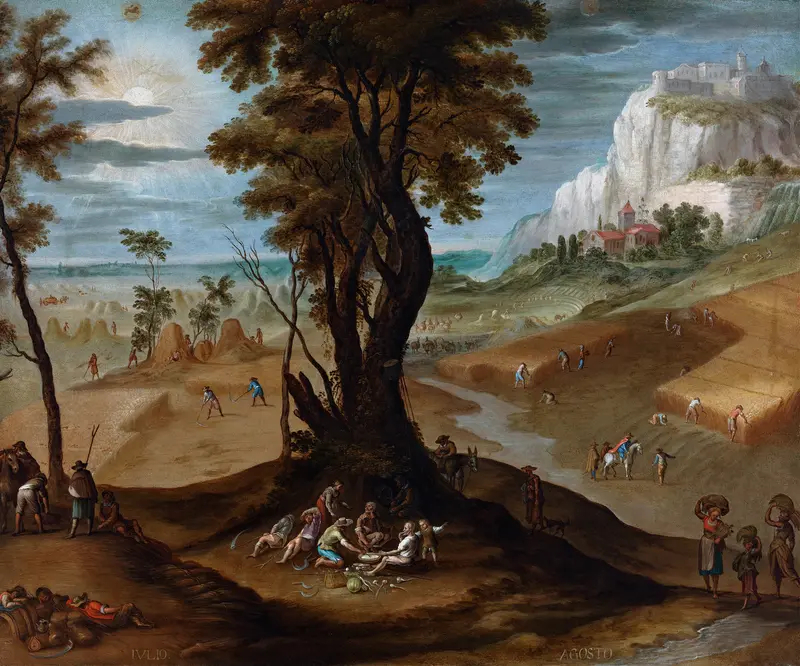
What first draws the eye in The Twelve Months of the Year (Los doce meses del año) is the sense of ordered abundance, as if the painter has caught the world in a moment of perfect harmony. The grand estate, with its stately terraces and lush gardens, seems to host a festival of daily life: musicians play in the shade, elegantly dressed figures stroll or converse, and a boat glides across the river, its passengers serenaded by a standing violinist. Each group is carefully placed, their gestures and glances weaving a tapestry of social ritual and gentle leisure.
The light falls softly, guiding us from the shaded foreground, where a fountain spills over rocks, up the stairs to the sunlit lawns and the distant, rolling countryside. The palette—verdant greens, warm earth, and the red roofs—speaks of late spring and early summer, a world cultivated but still open to the pleasures of the wild. Created in Mexico in the second half of the 17th century, this painting belongs to a tradition of allegorical cycles that marked the passage of time through the changing activities and landscapes of the year. Such works were often commissioned by wealthy patrons eager to display both their taste and their connection to the rhythms of nature and society.
In the Spanish colonial world, these scenes blended European models with local realities, celebrating not only the imported ideals of order and civility but also the richness of the land itself. Now housed in the Art of the Americas Building, this canvas stands as a rare window into the aspirations and daily pleasures of its era—inviting viewers to linger over each figure, each gesture, and to imagine the stories unfolding beneath the calm surface.
More Artworks by Antonio de Espinosa

More Genre Scene Art

Banquet of the Officers of the St George Civic Guard
Frans Hals

Rembrandt and Saskia in the Scene of the Prodigal Son
Rembrandt van Rijn

Bal du moulin de la Galette
Pierre-Auguste Renoir

Quadrille at the Moulin Rouge
Henri de Toulouse-Lautrec

A Burial at Ornans
Gustave Courbet

When Will You Marry?
Paul Gauguin