
Venezia — History & Facts
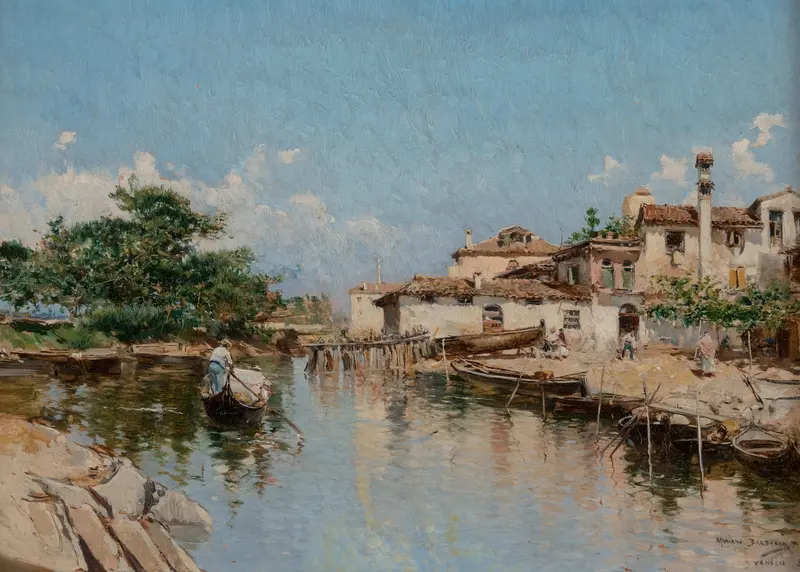
Could a single brushstroke hold eternity? In Venezia, the artist invites us to explore the delicate balance between the fleeting and the eternal, capturing the spirit of a city awakening in the soft morning light. Look to the left, where the buildings rise gracefully against a backdrop of pale blue sky, their facades bathed in a warm golden hue. Notice how the brushwork breathes life into the scene, with dappled reflections dancing upon the shimmering water. The palette harmonizes, blending earthy tones with subtle hints of vibrancy that evoke both nostalgia and hope, leading the eye toward the horizon where land meets sky. In the foreground, a solitary gondola glides silently, its presence a reminder of the intertwining paths of human experience and nature’s beauty.
The contrast between the serene water and the bustling energy of the city captures an emotional tension—an invitation to pause, to reflect, and to breathe. Each detail, from the ripple of the water to the distant bell tower, speaks to the awakening of not just Venice, but of the human spirit itself. Mariano Barbasán created this piece in 1889 while living in a period of significant artistic evolution in Europe, characterized by a growing fascination with Impressionism. As he painted Venezia, he was influenced by the interplay of light and color that defined the movement, reflecting the broader cultural shifts taking place in the art world and society at large.
This work stands as a testament to his observation of fleeting moments, encapsulating a city and its essence in one transformative gaze.
More Artworks by Mariano Barbasán
More Landscape Art

The Starry Night
Vincent van Gogh

View of Delft
Johannes Vermeer

Water Lilies
Claude Monet

The Grand Canal, Venice, looking north-west from the Ca' Corner to the Ca' Contarini degli Scrigni, with the campanile of Santa Maria della Carità
Canaletto

Windsor Castle
Canaletto

The Grand Canal looking North-East from the Palazzo Dolfin-Manin to the Rialto Bridge
Canaletto