Violante — History & Facts
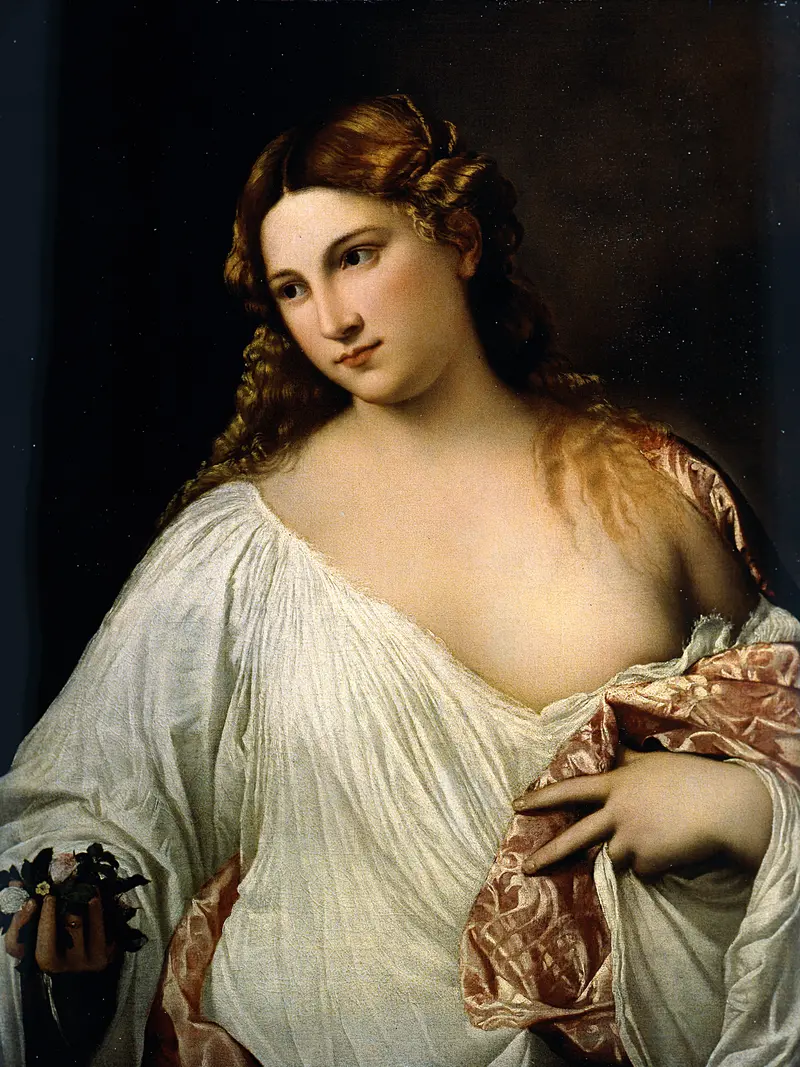
No other portrait by Titian has sparked as much speculation as Violante, not only about the sitter’s identity but even about its title. The name "Violante" first appears in 17th-century inventories, yet no contemporary document confirms who she was—though tradition links her to the daughter of Palma il Vecchio, a fellow Venetian painter. This air of mystery has made the painting a touchstone for debates over models, muses, and the intimate circles of the Venetian Renaissance.
For centuries, viewers have wondered if this was a personal tribute, a commission, or simply an idealized beauty. At the heart of the painting, a young woman turns gently towards the viewer, her gaze soft but direct, her golden hair cascading over her shoulder. Her right hand rests at her breast, a gesture that suggests modesty or perhaps a moment of self-reflection. The delicate play of light across her skin and the luminous blue of her dress draw the eye, while the lack of overt symbols leaves her story open-ended.
Unlike the elaborate allegories of Titian’s contemporaries, such as Lorenzo Lotto’s more narrative portraits, Violante offers intimacy and ambiguity, inviting us to search for meaning in her expression alone. The precise origins of Violante remain uncertain, including its patron and the circumstances of its creation around 1515. The painting’s fame grew as it passed through the hands of collectors in Venice, then Vienna, before entering the collection of the Gemäldegalerie in Dresden, where it hangs today. Over the centuries, attributions have occasionally wavered, but consensus now firmly places it among Titian’s early works, a testament to his evolving style and mastery of color and mood.
Violante stands as a quiet enigma in Titian’s career, bridging the world of private devotion and the emerging cult of the individual portrait.