White Cat and two Brimstone Butterflies — History & Facts
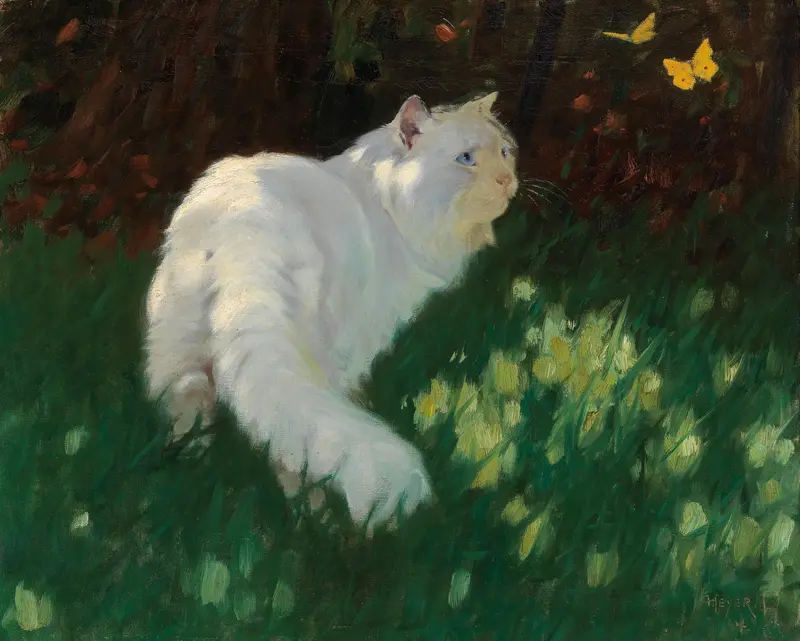
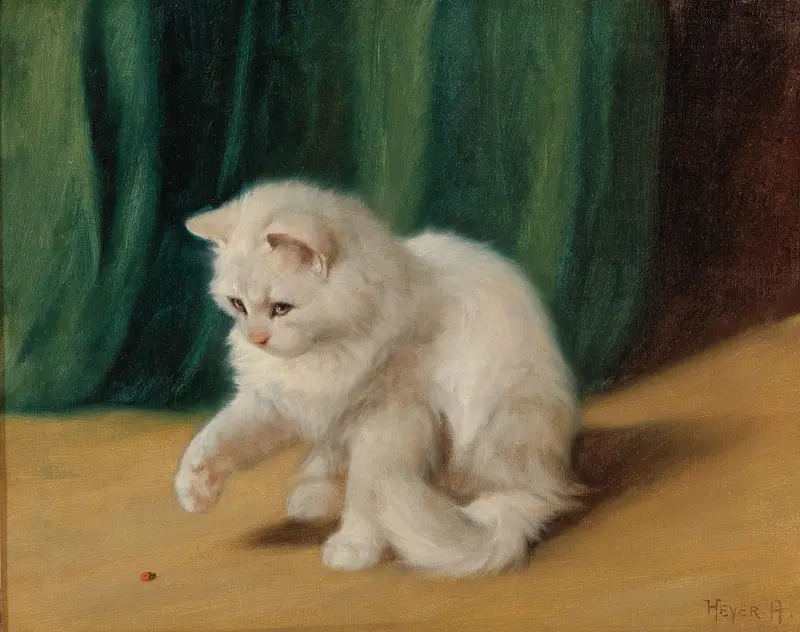
The first thing to catch the eye in White Cat and two Brimstone Butterflies is the way stillness and anticipation are locked together in a single, luminous moment. The white cat, poised and almost statuesque, sits grounded in the lower half of the canvas, its gaze fixed upward with a mixture of curiosity and calculation. Above, two pale yellow butterflies hover against a curtain of deep green and gold, their delicate wings catching the light.
The artist, Arthur Heyer, uses the contrast between the cat’s dense, soft fur and the fragile flutter of the butterflies to heighten the tension—will the peace hold, or is this the instant before a leap? Painted at the turn of the 19th to 20th century, this work belongs to a tradition that delighted in the close observation of animals, especially in domestic interiors. In Vienna and Budapest, where Heyer was active, such paintings found eager audiences among the urban middle class, who saw in them both a celebration of nature and a reflection of their own refined surroundings. The oil on canvas, now in the Dorotheum collection, is typical of the era’s fascination with the interplay of light, texture, and animal psychology.
History has kept few traces of this particular painting’s journey, but its quiet drama invites viewers to linger, following the cat’s gaze and wondering what might happen next.