
Woodcutters’ Meal — History & Facts
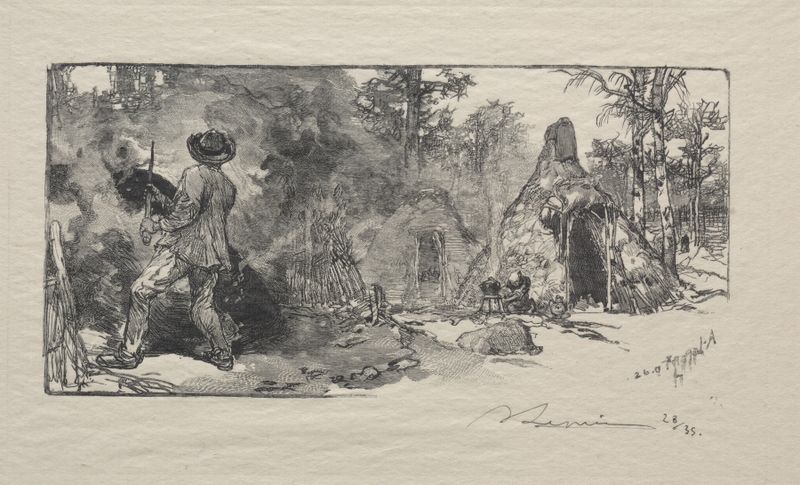
What secret hides in the quiet of the canvas? In Woodcutters’ Meal, a moment of unassuming tranquility unfolds, inviting the viewer to peer into the lives of laborers whose toil is etched into every line of their existence. Look to the left at the gathering of woodcutters, their forms tightly grouped yet distinctly individual, each captured in a moment of pause. The warm hues of ochre and earthy browns dominate the palette, contrasting sharply with the cool blues of the wooded backdrop. Notice how the light falls gently upon their faces, revealing weary expressions that hint at both exhaustion and camaraderie.
The intricate lines in the engraving draw attention to the textures of their clothing and the ruggedness of their surroundings, creating a palpable sense of the harshness of their daily lives. Within the simplicity of the scene rests a profound narrative. The act of sharing a meal hints at bonds forged in the throes of labor, yet there is an underlying void in the way their eyes gaze off into the distance—perhaps a longing for escape or reflection on their relentless work. The juxtaposition of the hearty meal against the backdrop of the dense forest evokes a tension between sustenance and struggle, life and the weight of labor.
This duality invites contemplation about the sacrifices made in pursuit of survival. Created in 1890, during a time when industrialization was reshaping society, Woodcutters’ Meal reflects Auguste Louis Lepère’s keen observation of the working class. Settled in France, he was deeply influenced by the Impressionist movement, yet his woodcuts maintain a stark realism that captures the essence of his subjects. At this moment in art history, the dialogue surrounding labor and life was intensifying, and Lepère’s work serves as a poignant chronicle of the human condition amidst change.
More Artworks by Auguste Louis Lepère
Browse all →
La Rue des Prêtres Saint-Séverin
Auguste Louis Lepère
Au Coin du Pont-aux-Doubles
Auguste Louis Lepère
Debarcadère des bateaux-omnibus
Auguste Louis Lepère

La Seine, au quai de la Rapée
Auguste Louis Lepère
L’Ecluse du Canal St. Martin
Auguste Louis Lepère

Le Boulevard Montmartre, le Soir
Auguste Louis Lepère

Une Chasse au Mont Gérard
Auguste Louis Lepère
Les Charbonniere
Auguste Louis Lepère
Notre Dame vue du Marché aux pommes
Auguste Louis Lepère

Le Palais des Arts Liberaux, Intèrieur
Auguste Louis Lepère





