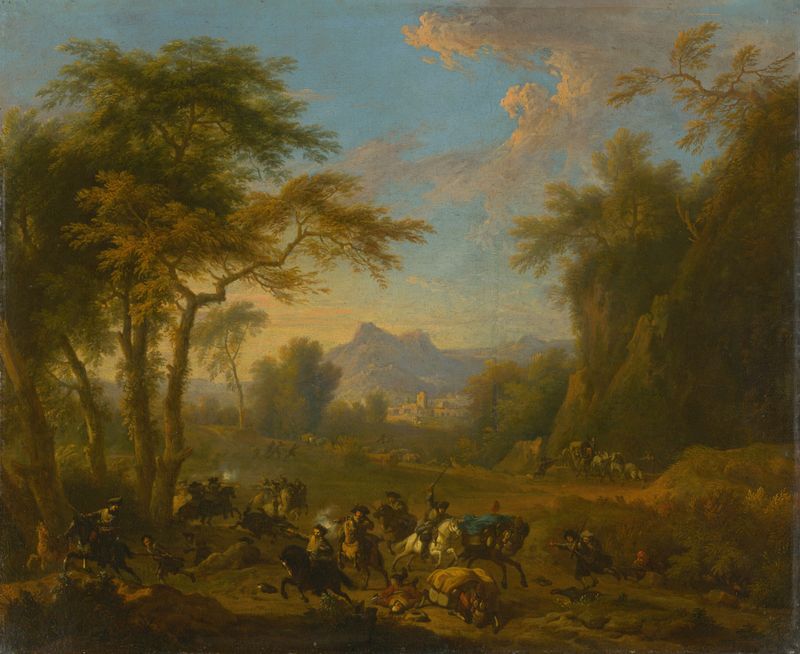
A hunting party preparing to depart from a country villa — History & Facts
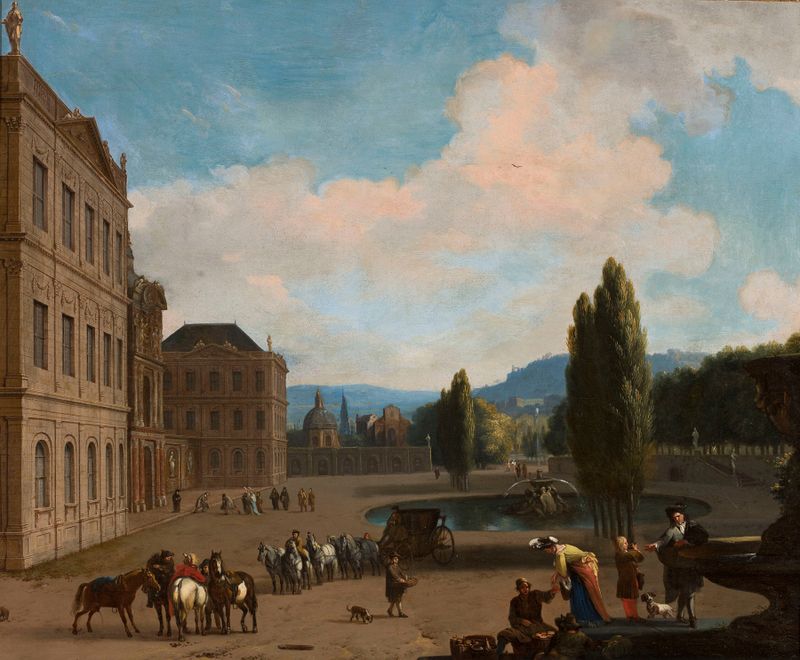
Where does light end, and longing begin? In the depths of A hunting party preparing to depart from a country villa, the interplay of shadow and illumination gives rise to an emotional void, inviting viewers to ponder the unseen narratives of desire and anticipation. Look to the left of the painting, where a sumptuous villa stands, its warm hues contrasting with the cool morning light that bathes the scene. Notice how the figures are positioned in a loose semicircle, their gestures revealing a sense of urgency and camaraderie. The artist’s deft brushwork captures the intricate details of their attire, with vibrant reds and muted earth tones harmonizing in a tapestry of texture.
Every stroke breathes life into the figures, from the stately presence of a lord to the energetic motion of a hunting dog, creating a tableau that pulsates with readiness. Yet, beneath this vibrant depiction lies a tension of absence—an empty space where a heartbeat should echo. The horses, poised and restless, mirror the unfilled void of expectation. This moment of preparation hints at the duality of adventure and vulnerability; while they stand on the brink of an exhilarating pursuit, they also linger in the shadow of the unknown.
Here, the promise of the hunt juxtaposes with the foreboding sense of what lies ahead, encapsulating the fragile boundary between excitement and longing. Created during an era when the art of hunting was steeped in social and cultural significance, the artist produced this work in the late 17th century, likely drawing inspiration from the grand estates of the Dutch elite. Amidst a flourishing art market, Jan van Huchtenburg found himself at the intersection of nature and nobility, capturing the essence of leisure and the inherent thrill of the chase within the context of an expanding world of exploration and impression.